
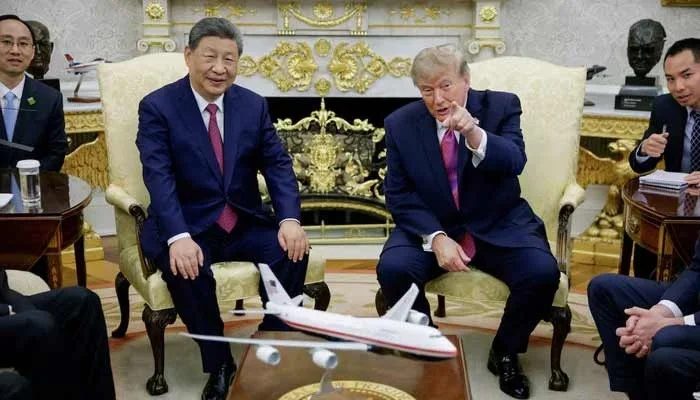
In recent months, US-China summits, regardless of their substantive outcomes, have been remarkably ceremonial and focused on optics. Earlier this May, Chinese President Xi Jinping, in a departure from usual protocol, walked about 100 steps down from his office in Beijing to welcome his American counterpart, Donald Trump.
Now, in September, Trump visibly went a step further when he received Xi on the tarmac as Xi stepped down from his aircraft during his visit to the US. The last time a US top leader went in person to the airport to receive his foreign counterpart was in 1962 when US president Kennedy greeted British prime minister Macmillan.
Some commentators argue that Trump's 'unprecedented' protocol for Xi indicates the balance of power in US-China relations is finally tilting towards Beijing. Such an opinion carries little weight.
Despite tremendous all-round progress in recent decades, China still lags well behind the US on all key military and economic indicators, except merchandise exports. But let's look at the substantive outcome of Xi's visit.
The summit was immediately preceded by negotiations between senior officials from the two countries, led by US Treasury Secretary Scott Bessent and Chinese Vice-Premier He Lifeng. The negotiations set the stage for the Trump-Xi talks.
Arguably, the most significant outcome was the two sides' agreement to extend their trade truce, due to expire in November, to January 2027. For background, the trade truce was reached in October 2025 in Busan, South Korea, when the world's two largest economies agreed not to raise import duties on each other's products, reversing the tit-for-tat tariff escalation triggered by Trump's Liberation Day (April 2, 2025) trade war.
As part of the truce, Beijing suspended its controls on exports of rare earths and critical minerals, which are vital to high-tech industries in the US. The two sides also agreed to operationalise the US-China Board of Trade, a mechanism to strengthen bilateral trade established during Trump's May visit to Beijing.
Reining in the untrammelled rise of artificial intelligence (AI) was also on the agenda. Xi stated at the White House that the US and China have "both the capability and responsibility to develop and manage AI for good, and ensure that the development of AI is always under human control and serves the well-being of the people".
As in May 2025, no joint statement was issued at the end of the latest Trump-Xi summit. According to an announcement made by the office of the State Council (cabinet) of China, the two countries reached a consensus on several matters including: extending the trade truce; building a constructive bilateral relationship of strategic stability based on respect, fairness and reciprocity; supporting each other on hosting international events later this year including the 2026 Asia-Pacific Economic Council (APEC) meeting by China in November and the G20 summit in December by the US; keeping international maritime routes open and toll free; Iran not developing nuclear weapons; jointly preventing drug trafficking; and establishing a joint AI dialogue to exchange views on AI-related risks and benefits.
The Beijing-Washington consensus that Iran shouldn't develop nuclear weapons is a major takeaway of the summit.