
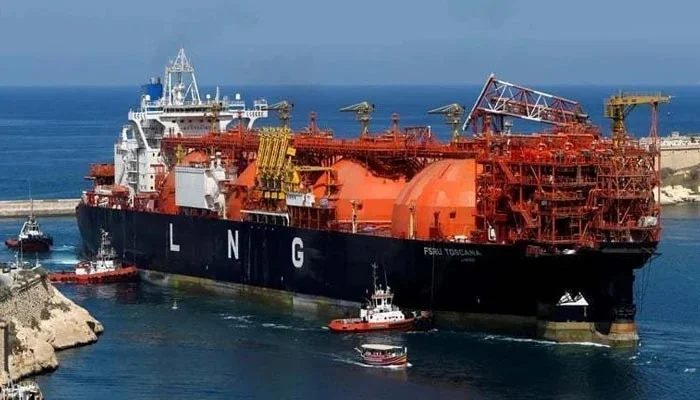
Pakistan received a much-needed liquefied natural gas (LNG) cargo from Qatar on Tuesday, with the vessel Al-Areesh berthing at Engro's LNG terminal at 11:05 am and regasification commencing at noon at a rate of 150 million cubic feet per day (mmcfd), providing some relief to the country's strained gas supply system.
The arrival marks the first LNG cargo received in October, as authorities scramble to arrange additional shipments from Qatar amid disruptions to LNG supplies and continued uncertainty surrounding maritime traffic through the Strait of Hormuz, a senior official of the Petroleum Division told Probes Pakistan.
Officials are making efforts to secure three LNG cargoes from Qatar with international assistance. However, under the latest supply scenario, Pakistan is expected to arrange only two cargoes during October, similar to the two vessels received in September.
Engro's LNG terminal had remained non-operational since September 26 because of the unavailability of an LNG vessel. With the arrival of Al-Areesh, regasification has resumed, allowing 150 mmcfd of re-gasified LNG (RLNG) to be injected into the national gas network.
The situation at the country's second LNG terminal, operated by Pakistan GasPort Limited (PGPL), remains challenging. The terminal has been non-operational since October 9 due to a lack of LNG inventory.
Authorities expect to arrange another cargo within the next 8 to 10 days for delivery to the facility. The interruption in LNG supplies has already affected fuel availability for power generation.
Between October 9 and October 13, no LNG was being regasified at either terminal, leaving the power sector with a supply of only around 38 mmcfd for electricity generation as of October 13. Pakistan's LNG supply outlook remains uncertain following QatarEnergy's declaration of force majeure on March 4, after Iran attacked Ras Laffan, Qatar's largest LNG production facility, on March 2, 2026.
QatarEnergy has extended the force majeure twice, with the latest extension running until November 6. If the situation in the Strait of Hormuz does not improve, the suspension could be extended further, potentially disrupting LNG imports throughout the winter season.
Any prolonged disruption in LNG imports could place additional pressure on domestic gas supplies, electricity generation and industrial consumers during the peak winter demand period. Pakistan is anticipating a sharp increase in gas demand during the upcoming winter season, with Sui Northern Gas Pipelines Limited (SNGPL) requirement projected to rise from the existing 500 mmcfd to 1,550 mmcfd.
Meanwhile, Sui Southern Gas Company (SSGC) demand is expected to increase from 300 mmcfd to 500 mmcfd. Apart from the LNG shortage, Pakistan's gas supply system is facing several domestic production and infrastructure-related constraints, according to line-pack data as of October 13.
Gas consumption in the fertiliser sector stood at 90 mmcfd on Tuesday, compared with 88 mmcfd a day earlier. Gas input from MOL's CPF and GPF facilities fell to 124 mmcfd on October 12 because of an annual turnaround at the plant.
The current supply rate stands at 123 mmcfd against a normal level of 160 mmcfd. Meanwhile, 31 mmcfd of gas supply from the Bettani field has remained suspended since 11:45 am.