
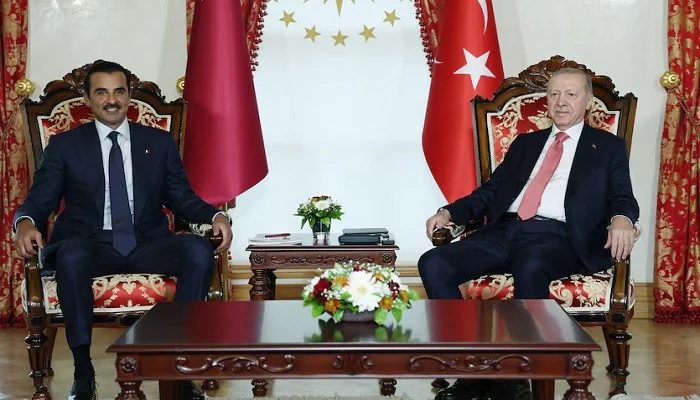
Turkish President Recep Tayyip Erdogan and Qatari Emir Sheikh Tamim bin Hamad Al Thani signed a mutual defence agreement in Istanbul on Friday to deepen military cooperation.
- The pact mandates mutual support against external armed attacks and increased military coordination.
- Both nations agreed to expand joint exercises, defence-industry partnerships, and personnel training exchanges.
- The leaders discussed regional conflicts, including the war involving Iran, Gaza, Syria, and Libya.
Turkiye and Qatar Defence Pact
The agreement followed the 12th session of the Supreme Strategic Committee between the two nations. Under the terms, Turkiye and Qatar committed to strengthening collective defence and consulting on security threats. The joint communique stated that the pact reflects a commitment to protecting sovereignty and territorial integrity. While the statement outlined broad goals, it did not provide specific operational details regarding the mechanisms for responding to an armed attack. President Erdogan noted that the agreement adds a new dimension to the brotherly ties between the two countries. Beyond military matters, the leaders expressed readiness to expand energy cooperation, specifically regarding liquefied natural gas trade.
Regional Security and Alliances
President Erdogan stated that Ankara and Doha would continue working together to prevent a renewed outbreak of war in the Gulf and promote regional peace. The Qatari emir visited Istanbul for the signing after attending the United Nations COP31 climate summit in southern Turkiye. This move aligns with Ankara's recent efforts to expand its regional defence partnerships. In August, Turkiye, Pakistan, and Saudi Arabia signed the Mecca Joint Defence Agreement, which treats an armed attack on one member as an attack on all three. The Turkish parliament ratified this trilateral pact last week.
The Mecca agreement involves Nato member Turkiye, nuclear-armed Pakistan, and Saudi Arabia. It gained significance due to regional hostilities, such as attacks by Yemen's Houthi movement on Saudi territory. Turkish officials maintained that the Mecca agreement is not directed against any other country and remains open to participation by additional states, including Egypt. Furthermore, in October, Qatar, Indonesia, Pakistan, and Turkiye signed the Badr agreement in Doha. This multilateral memorandum of understanding aims to strengthen defence cooperation among the four participating nations. Through these various agreements, Turkiye continues to solidify its strategic position across the Middle East and beyond.