
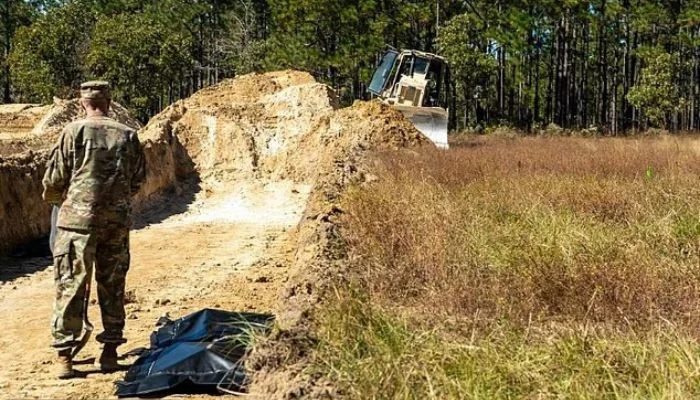
The United States (U.S.) Army has initiated a grim exercise involving training soldiers to dig mass graves for thousands of fallen personnel as global tensions persist. This marks the revival of battlefield burial procedures not practiced since the Korean War in the 1950s.
While the drills coincide with escalating global instability, military officials have not linked the exercises to any specific conflict. The training, dubbed 'Operation Dragon Covenant Phase II', involves military engineers, mortuary affairs specialists, and chaplains to prepare for a war in which casualties could overwhelm the Army's ability to recover and transport bodies home.
According to the Army, crews operating eight bulldozers and four excavators could potentially prepare temporary burial sites for as many as 2,400 people within 24 hours. During the exercise, soldiers used heavy machinery to dig trenches designed to accommodate 20 bodies each, completing individual trenches in an average of one hour and 15 minutes.
The military used simulated remains to test whether bodies could be buried without damage and later recovered for identification and repatriation. Sergeant First Class Delbert Ruede, a senior fatality management official, stated the exercise was intended to replace improvised wartime arrangements with procedures tested under realistic conditions.
During the wars in Iraq and Afghanistan, American forces were generally able to transport fallen personnel home relatively quickly. However, a future conflict involving a powerful or distant adversary could disrupt evacuation routes and force commanders to establish temporary battlefield cemeteries.
Military chaplains also participated in the drills, preparing for circumstances in which individual funeral services might not be possible. The Army plans to conduct another phase of the exercise in spring 2027, incorporating additional medical and security operations.
This proactive approach underscores the Pentagon's shift toward preparing for large-scale, high-intensity combat scenarios that have not been a primary focus for the U.S. military in recent decades. As geopolitical rivalries intensify, the ability to manage mass casualties has become a critical component of military readiness.
The logistical challenges of such operations are immense, requiring coordination between engineering units and specialized mortuary teams to ensure that the dignity of the fallen is maintained even under the most dire battlefield conditions. The integration of chaplains into these exercises highlights the psychological and spiritual dimensions of the training.
Providing comfort and maintaining religious protocols during mass burial operations is a significant challenge that the Army is now actively addressing through these simulated environments. Looking ahead, the 2027 phase of the operation is expected to refine these protocols further.
By testing the limits of their equipment and personnel, the U.S. Army aims to ensure that it is prepared for any eventuality, regardless of how catastrophic the battlefield environment may become. Ultimately, while the nature of the training is somber, military leadership maintains that such preparations are essential for the modern era.
By acknowledging the potential for high-casualty conflicts, the Army is taking necessary steps to ensure that its personnel are supported, even in the event of the most tragic outcomes.