
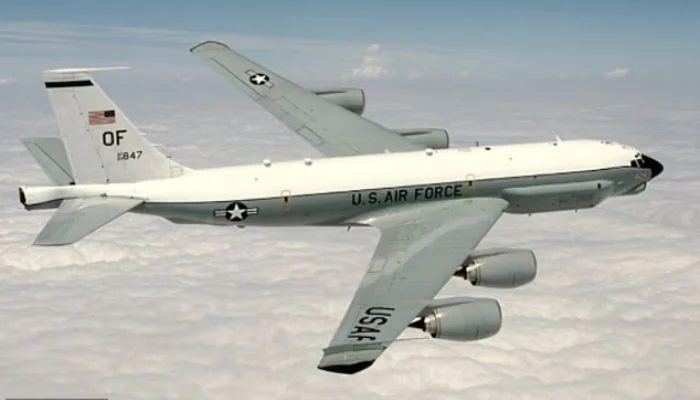
One of the United States' (U.S.) two highly specialised spy aircraft designed to identify enemy radar systems has landed in Britain at an undisclosed location amid fears that the U.S. could renew military strikes against Iran. The RC-135U Combat Sent reconnaissance aircraft, operating under the call sign COBRA49, was tracked crossing the Atlantic Ocean on Wednesday before landing at RAF Mildenhall in Suffolk, England.
According to flight tracking data, the plane departed Portsmouth International Airport in New Hampshire at 1:51 a.m. Eastern Time and flew for six hours and 42 minutes before landing in the UK. The aircraft, identified by its tail number 64-14849, had previously travelled from Offutt Air Force Base in Nebraska, where both of the U.S. Air Force's Combat Sent aircraft are stationed.
Unlike conventional spy planes, the RC-135U is equipped with sophisticated electronic surveillance systems capable of detecting, identifying, and analysing foreign military radars. The intelligence gathered by the plane helps U.S. forces understand enemy air defence networks and develop ways to evade or defeat them during military operations.
Its arrival in Britain comes amid renewed tension between Washington and Tehran, with speculations mounting over the possibility of another round of American strikes against Iran. However, President Donald Trump told the Financial Times on Tuesday that the U.S. had no immediate plans to attack Iran, although American forces remained prepared to act if necessary.
The aircraft's next destination and operational assignment have not been publicly disclosed. While military observers have suggested it could eventually head towards the Middle East, its presence in the UK does not establish an imminent attack.
According to the U.S. Air Force, Combat Sent aircraft are deployed for intelligence gathering during peacetime as well as military operations. The deployment of such high-value assets is often seen as a strategic signal in international diplomacy.
By positioning the RC-135U in Europe, the U.S. maintains a flexible posture that allows for rapid response to evolving threats in the Middle Eastern theatre. Military analysts note that the ability to map radar signatures is a critical component of modern aerial warfare, providing a significant tactical advantage.
As the situation remains fluid, global observers are closely monitoring the movements of U.S. military assets. The Pentagon has maintained that these routine deployments are part of ongoing efforts to ensure regional stability and protect American interests abroad.
The international community continues to call for de-escalation, hoping that diplomatic channels will prevail over military confrontation.