
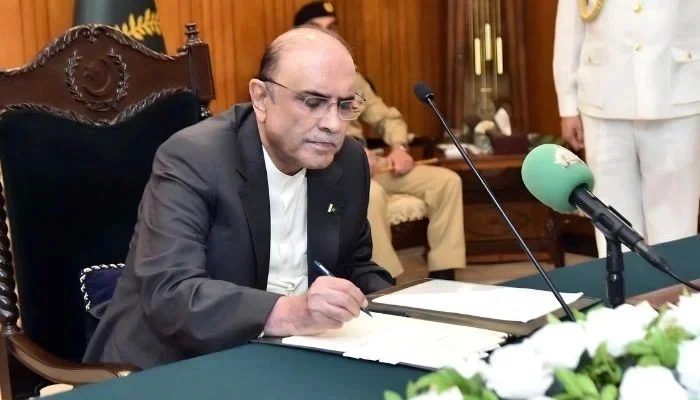
President Asif Ali Zardari, the first civilian president of Pakistan to serve two terms, has signed proclamations imposing governor's rule in three of the country's four provinces during his tenures in 2009, 2013, and 2026. This historical pattern reflects the evolving political landscape of Pakistan, where constitutional mechanisms are frequently utilized to address administrative crises or political deadlocks.
In an interesting turn of events, 17 years ago in 2009, President Zardari signed the proclamation imposing governor's rule in Punjab after the court disqualified the then-chief minister, Shehbaz Sharif. This move marked a significant escalation in the power struggle between the Pakistan Peoples Party (PPP) and the Pakistan Muslim League-Nawaz (PML-N) during that era.
Shehbaz Sharif reacted strongly to the decision and, along with his elder brother and PML-N supremo Nawaz Sharif, led a long march demanding the restoration of the judiciary and the lifting of governor's rule in Punjab. The political tension eventually subsided, but the event remained a defining moment in the country's democratic history.
Interestingly, Shehbaz Sharif, who was at loggerheads with President Zardari at the time, is now the prime minister and heads the federal cabinet that has approved the move to impose governor's rule in Khyber-Pakhtunkhwa (KP). The two leaders, who were on opposing sides in 2009, are now on the same page regarding the latest decision, highlighting the fluidity of political alliances in Pakistan.
Later, in January 2013, President Zardari signed another proclamation imposing governor's rule in Balochistan following protests by the Hazara community, whose members had been killed in a devastating suicide bombing. The tragedy sparked nationwide outrage and intense pressure on the provincial government.
The community demanded the removal of the provincial government, led by then-chief minister Aslam Raisani. Following a visit by then-prime minister Raja Pervaiz Ashraf to Quetta for talks with the bereaved families, governor's rule was imposed, effectively removing Raisani's government from power to restore order.
The arrangement was lifted shortly before the 2013 general election, allowing the provincial government to be restored and the democratic process to continue. This precedent showed how the federal government often uses the governor's rule as a temporary measure to manage extreme provincial instability.
Now, in 2026, President Zardari has signed the summary for imposing governor's rule in KP, a move that would prevent the elected chief minister from continuing to head the provincial administration. The decision has sent shockwaves through the political landscape of the province, leading to widespread speculation about the future of local governance.
The Pakistan Peoples Party (PPP) already has a senior party figure, Faisal Karim Kundi, serving as KP governor. His role is expected to become central to the administration of the province during this period of suspension of the provincial assembly's executive powers.
Whether he will be replaced by a nominee of the PML-N, and how long governor's rule will remain in place, are among the questions being debated in political circles. As the nation watches, the implications of this decision for the stability of KP and the broader federal-provincial relations remain a subject of intense scrutiny.