
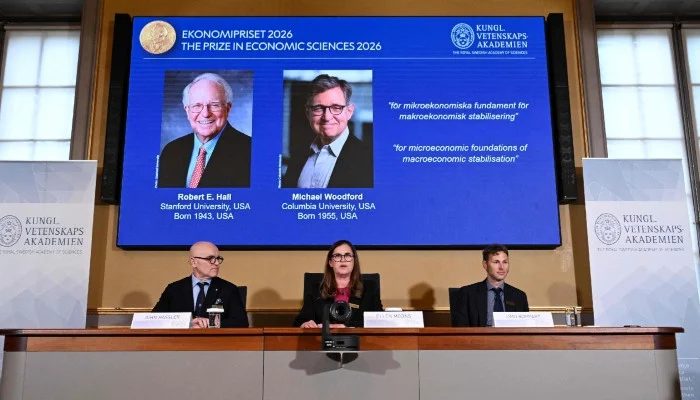
Americans Robert Hall and Michael Woodford won the 2026 Nobel economics prize "for microeconomic foundations of macroeconomic stabilisation," the Royal Swedish Academy of Sciences said on Monday. The prestigious award, formally known as the Sveriges Riksbank Prize in Economic Sciences in Memory of Alfred Nobel, is the final prize to be given out this year and is worth 12 million Swedish crowns ($1.2 million).
The economics prize, first awarded in 1969, is not one of the original five awards created in the 1895 will of industrialist and dynamite inventor Alfred Nobel, but was established by Sweden's central bank. The majority of previous laureates have been from the United States.
Only three women have ever won, most recently Claudia Goldin in 2023 for work on how gender has affected pay and employment over time in the United States. Analysis by the Institute for Scientific Information, part of Clarivate, had picked researchers working on monetary policy, the economics of information technology and evolutionary economic theory as possible recipients.
Last year's winners, Joel Mokyr, Philippe Aghion and Peter Howitt, won for work on "creative destruction" and how new technology and production methods can boost growth and living standards. The Nobel prizes for medicine, physics, chemistry, literature and peace were announced last week.
The selection of Hall and Woodford highlights the ongoing importance of micro-foundations in understanding complex macroeconomic trends. Their research has provided central banks and policymakers with essential tools to navigate periods of high inflation and economic volatility.
Experts suggest that the committee's decision reflects a broader trend of recognizing practical applications of economic theory. By focusing on the micro-level behaviors of firms and households, the laureates have bridged the gap between abstract models and real-world economic outcomes.
The Nobel committee noted that the duo's contributions have been instrumental in shaping modern fiscal policy frameworks. Their work remains a cornerstone of graduate-level economic curricula across the globe, influencing generations of researchers.
As the global economy faces new challenges, including the rapid integration of artificial intelligence and shifting trade dynamics, the insights provided by Hall and Woodford offer a roadmap for stability. Their research continues to be cited in major policy debates worldwide.
The award ceremony is scheduled to take place in Stockholm in December, where the laureates will receive their medals and diplomas. This event marks the culmination of the annual Nobel season, celebrating excellence in various scientific and humanitarian fields.
With this announcement, the 2026 Nobel season officially concludes, leaving the academic community to reflect on the significant contributions of this year's winners to the advancement of human knowledge and global economic prosperity.