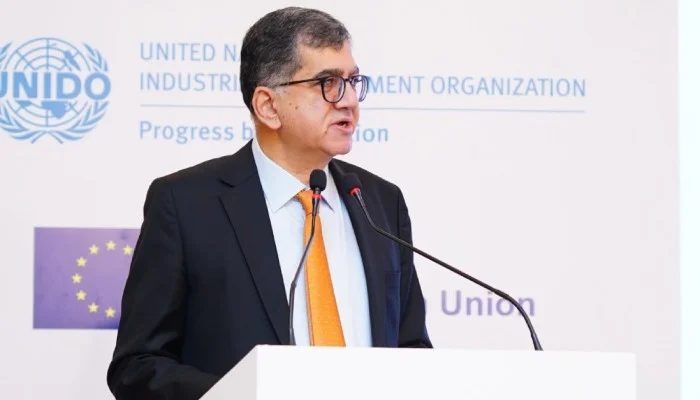
Pakistan's microfinance industry must measure success by whether borrowers grow their businesses and incomes, not just by how many people it lends to, officials and industry leaders said at a two-day conference that ended on Friday. The 10th Annual Microfinance Conference (AMC-X), organised by the Pakistan Microfinance Network (PMN) with the United Nations Industrial Development Organisation (UNIDO), brought together government officials, regulators, lenders and development partners, according to a statement.
Finance Minister Muhammad Aurangzeb, speaking by video link, said Pakistan's focus is shifting from macroeconomic stabilisation towards sustainable growth, and that helping more people and small businesses access financial services should be part of that effort. He called for greater use of cash-flow-based rather than collateral-based lending, digital credit tools and alternative data to bring more borrowers into formal finance, particularly in agriculture and small and medium enterprises (SMEs).
"It's not just how much you lend or how many borrowers, but also start measuring outcomes," Aurangzeb said, highlighting borrower graduation, job creation and women's economic participation as important measures of success. Amir Khan, PMN chairperson and chief executive of HBL Microfinance Bank, said microfinance should be woven into the broader financial system.
"The principle behind everything to follow is to mainstream microfinance into the financial ecosystem, not a parallel track," he said. Khan stressed that the sector's next decade should be judged not only by outreach but by whether clients are able to progress towards stronger businesses, assets and financial independence.
In his address, Chief Minister Sindh Syed Murad Ali Shah emphasised that financial inclusion must move from mere access to quality and relevance, with products designed around clients' incomes, seasons and risks. He also welcomed the launch of the PAIDAR Innovation Labs, which will bring financial institutions and rural enterprises together to co-design and test products for underserved markets in Sindh.
The initiative builds on PAIDAR's wider work on rural enterprise development, risk-sharing and access to finance. Among the main outcomes, a guarantee-based financing facility under the EU-funded Poverty Alleviation and Inclusive Development Across Rural Sindh (PAIDAR) programme will expand to 4.2 billion rupees from 200 million rupees in partnership with the National Credit Guarantee Company Limited (NCGCL).
The participation will expand from three to eight financial institutions. The programme will cover borrowers in Larkana, Badin, Thatta, Sujawal and Tharparkar districts.
At least 50 per cent of the financing is earmarked for women. NCGCL will provide risk-sharing for direct microenterprise lending, as well as guarantees for commercial bank and development finance institution credit lines to microfinance institutions.
The scheme is backed by a two-million-euro grant from the EU-funded UNIDO programme, covering beneficiary identification, technical assistance and mark-up support. Separately, Pakistan Microfinance Investment Company (PMIC) and the National Rural Support Programme (NRSP) signed a 1 billion rupee financing facility under the PMIC-KfW Renewable Energy Initiative through Microfinance (PRIME) programme.
Deputy Governor, State Bank of Pakistan, Saleem Ullah, concluded the session by stressing the need for customer-centred innovation and commercial sustainability to ensure the long-term viability of the sector.