
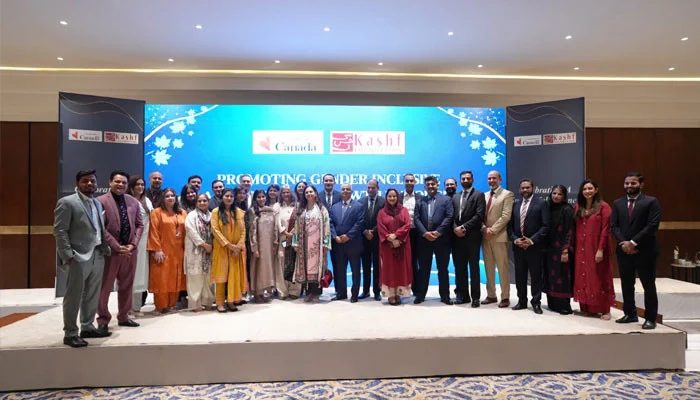
A 10-year partnership between the Canadian High Commission and Kashf Foundation has reached more than 1.6 million people in 63 districts across Pakistan, supporting women's access to finance, business training, and health education. Funded by Global Affairs Canada, the initiative provided more than 1.4 million women with financial literacy and business development training.
According to a statement issued on Monday, awareness campaigns on family planning, girls' education, and cybercrime reached more than 120 million viewers. An independent assessment covering 2,596 households across 14 districts found that women who received microloans and financial management training increased their incomes by 17 percent and savings by 34 percent.
Participants who received loans and business training earned 26 percent more than those who did not receive training. Some 94.5 percent of surveyed clients reported greater participation by women in household decisions, while 83.4 percent said their families supported their businesses.
Canadian High Commissioner to Pakistan Tarik Ali Khan stated that women's economic empowerment is essential for prosperity. He emphasized that the collaboration has set a benchmark for sustainable development and gender equality in the region.
The project focused on breaking systemic barriers that prevent women from entering the formal economy. Kashf Foundation founder Roshaneh Zafar urged policymakers and businesses to expand initiatives combining financial services, skills development, and efforts to challenge restrictive social norms.
She noted that the success of this decade-long effort proves that when women are given the right tools, they become catalysts for economic growth. The program also integrated digital literacy components, ensuring that women could navigate modern financial platforms safely.
This was particularly crucial during the expansion of digital banking services across rural areas of Pakistan. Furthermore, the health education component addressed critical issues such as maternal health and nutrition, which are often overlooked in standard microfinance models.
By adopting a holistic approach, the partnership ensured that economic gains were matched by improvements in the quality of life for families. The data collected from the 14-district assessment serves as a roadmap for future interventions.
It highlights the necessity of combining capital with knowledge to achieve long-term financial independence for marginalized communities. As the partnership concludes its current phase, both organizations expressed commitment to continuing their advocacy for gender-inclusive economic policies.
The impact of this initiative remains a significant milestone in Pakistan's journey toward achieving the Sustainable Development Goals. Ultimately, the success of this program underscores the importance of international cooperation in fostering local entrepreneurship and empowering women to lead their households toward financial stability.