
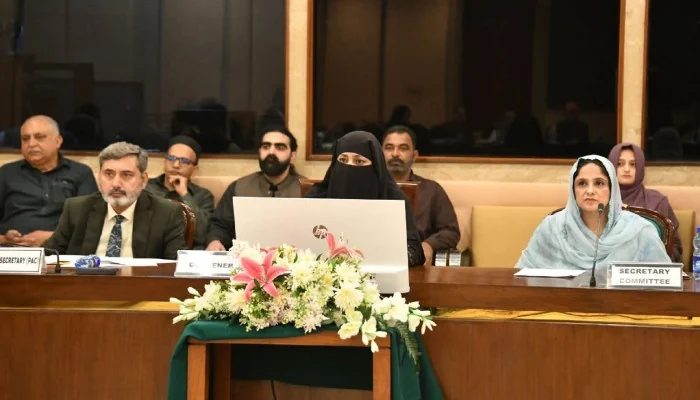
A subcommittee of the Public Accounts Committee was on Monday informed that the cost of the Clean Drinking Initiative (CDI) and Clean Drinking Water for All (CDWA) projects had escalated from Rs1 billion to Rs12.2 billion within a year, with audit officials raising serious questions about their planning, implementation and sustainability.
The subcommittee, convened by Shahida Akhtar Ali, reviewed audit objections relating to the Ministry of Planning and Development for the financial years 2010-11 and 2013-14, including the utilisation of Rs33 million allocated under the Drought Emergency Relief Assistance Programme. During the meeting, audit officials said feasibility studies had not been conducted before launching the clean drinking water projects, despite their importance for proper planning and implementation.
They told the committee that the original allocation of Rs1 billion had increased to Rs12.2 billion within a year, and the entire amount had also been spent. Against the planned 6,600 schemes, only 1,300 had been developed, of which around 200 were non-operational.
Audit officials expressed doubts about the sustainability of the remaining 1,100 schemes, saying that none of them was likely to remain sustainable. Senator Bilal Mandokhail criticised the handling of the projects, saying that Rs12 billion had effectively been thrown away.
He questioned whether the projects had been implemented across the country, to which Planning Ministry officials replied in the affirmative. Mandokhail also asked whether any action had been taken against officials of the Environment Department.
Planning officials explained that the project had initially been under the Environment Department before being transferred to the Ministry of Industries and subsequently to another ministry. It was later handed over to the Planning Ministry.
The planning secretary said the ministry had proposed a special audit of the projects and suggested that the matter be referred directly to the National Accountability Bureau (NAB) or the Federal Investigation Agency (FIA). Audit officials called for a formal inquiry, pointing out that the PC-II document was the key controlling document for project preparation and that repeated changes and revisions had been made to the projects.
NAB officials informed the committee that one of the firms involved in the project had been registered after the contract was awarded. They said the NAB had filed a reference in 2020, but the matter had now been referred to the FIA.
Expressing concern over the failure to provide clean drinking water, Shahida remarked that humans and animals were drinking water from the same pond. The subcommittee directed the planning secretary to submit a report on the matter within one month.
It also examined audit objections concerning Rs33 million allocated under the Drought Emergency Relief Assistance Programme. Officials from the Khyber Pakhtunkhwa and Balochistan governments presented their positions before the committee.
Shahida expressed dissatisfaction with what she termed the continued non-serious attitude towards resolving the audit objections. She observed that anomalies were being reported in every department.
Bilal Mandokhail asked the Planning Department to obtain PC-IV documents for its projects. Audit officials said the planning secretary and the relevant allocation authorities had access to all the required forums and procedures, describing the matter involving the National Highway Authority (NHA) as incomplete.
The committee concluded the session by stressing the need for strict financial discipline and accountability across all federal and provincial developmental frameworks to prevent massive public fund leakages.