
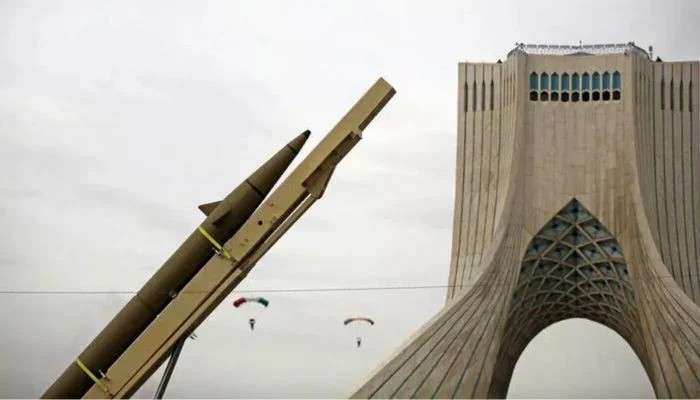
Iran's Kheibar Shekan missile, also known as "Castle Breaker", has become a centrepiece of Tehran's military response in the escalating US-Israel conflict, showcasing Iran's ability to strike US assets across the Middle East with precision and speed. This is a third-generation, medium-range ballistic missile that showcases a range of around 1,450 kilometres (900 miles), placing US military installations throughout the Gulf States, Jordan, and Iraq within striking distance.
It works through a solid-fuel propulsion system that enables launch within minutes during a crisis, in contrast to liquid-fuel missiles that need hours of fueling, making it harder for adversaries to detect and preempt attacks. Most importantly, the Kheibar Shekan has a manoeuvrable re-entry warhead capable of adjusting its trajectory during final descent. These measures are likely to help the missile evade radar tracking and missile defence systems such as US Patriot batteries, thereby offering it an upper hand against conventional ballistics that move in a parabolic path.
The Castle Breaker has been widely used in recent times, as evidenced by attacks conducted on US military forces in Jordan, Bahrain, Kuwait, and Iraq's Erbil. It is reported that the Islamic Revolutionary Guard Corps (IRGC / پاسداران انقلاب) used the missile against Muwaffaq Salti Air Base and King Hussein Air Base in Jordan. This attack caused massive destruction and loss of lives of American forces.
The present flare-up occurred on 31 August when US forces bombed IRGC bases on Larak Island of Iran. Iran reacted to this bombing with its own missiles and drones, setting off a chain reaction of attacks, thus raising concerns about the safety of the Strait of Hormuz, through which 25 per cent of global oil passes.