
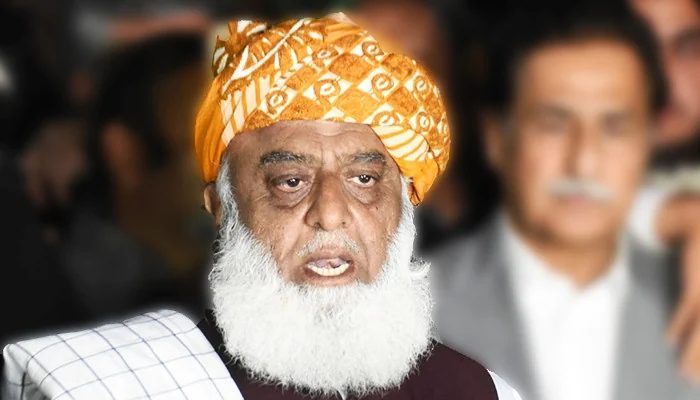
Jamiat Ulema-e-Islam-Fazl (JUI-F) chief Maulana Fazlur Rehman has invited the government to agree on a Charter of Democracy, warning that the opposition is prepared for confrontation if the government fails to change its course. "We are ready for 'Damadam Mast Qalandar' if you do not mend your ways," he stated in the National Assembly.
Fazl accused the federal government of misusing the Constitution to impose governor's rule in Khyber Pakhtunkhwa (KP), arguing that the move undermines democracy, constitutional supremacy, and the rule of law. He described the imposition of governor's rule and emergency measures as unprecedented, comparing the situation to the partial martial law imposed in Lahore in 1953.
He further criticized the invocation of Articles 232 and 234. Fazl alleged that the governor's rule is linked to foreign powers seeking access to mineral reserves in the province's tribal areas, questioning why the matter is being concealed from the public and parliament.
"We are not opposed to investment, but why is this being kept secret from the nation?" he asked. Pakistan Tehreek-e-Insaf (PTI) Chairman Barrister Gohar Ali Khan, speaking on a point of order, noted that several party leaders remain missing.
He demanded an end to political victimization, warning that the situation in KP would worsen otherwise. He highlighted that PTI leaders have been detained and expressed regret that non-political women affiliated with the party were held for two consecutive months.
"We stand with the country, the state, and democracy," he said, questioning the utility of parliament if members and their families lack protection. Federal Law Minister Azam Nazeer Tarar stated there are no differences between the Pakistan Peoples Party (PPP) and the government regarding legislation, noting that bills are discussed with coalition partners before cabinet presentation.
Regarding production orders, Tarar explained that the National Assembly Speaker exercises discretion based on the sensitivity of cases and pending legal matters. He added that the case of Junaid Akbar is currently sub judice in the Peshawar High Court.
Meanwhile, Senate Opposition Leader Allama Raja Nasir Abbas Jafri and Maulana Fazlur Rehman endorsed the need for a new charter of democracy. The Maulana, leading a delegation, met with the Senate Opposition Leader, who also heads the Majlis Wahdat-e-Muslimeen (MWM), to discuss the political impasse.
The meeting underscored a growing consensus among opposition ranks that the current political climate requires a unified approach to protect democratic institutions. Both leaders emphasized that the government must prioritize national stability over political maneuvering.
As the parliamentary session continues, the call for a Charter of Democracy remains a central point of debate, reflecting the deep-seated tensions between the ruling coalition and the opposition parties regarding the future of governance in Pakistan.