
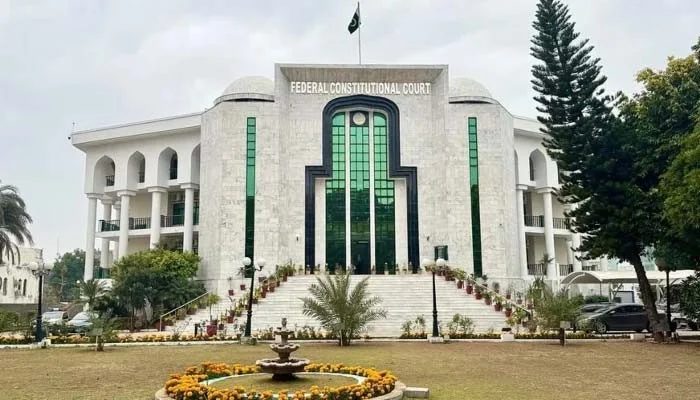
The Federal Constitutional Court (FCC) on Thursday declared infructuous a petition filed by MNA Sher Afzal Marwat challenging Sohail Afridi's election as Khyber Pakhtunkhwa chief minister. The FCC bench, headed by Chief Justice Aminuddin Khan, declared the petition infructuous following the imposition of governor's rule and an emergency in the province.
During the hearing, Chief Justice Aminuddin Khan observed that Afridi was no longer holding the office of chief minister and that the petition could not proceed after the new measures. Justice Ali Baqar Najafi remarked that governor's rule and the imposition of an emergency were separate legal matters.
At this, Marwat told the court that he also wanted to challenge governor's rule and the emergency. In reply, the chief justice said a fresh petition could be filed if the emergency was lifted and Afridi was restored as chief minister.
The estranged Pakistan Tehreek-e-Insaf (PTI) lawmaker Sher Afzal Marwat moved the FCC against the resignation of former KP chief minister Ali Amin Gandapur, who preceded Sohail Afridi. In his petition, Marwat, who was expelled from the PTI by the party founder for his continued violation of party discipline in February last year, argued that Gandapur's resignation was obtained "under pressure," adding that his resignation had no legal status.
Marwat pleaded with the apex court to declare Gandapur's resignation unconstitutional and void, arguing that his de-notification was illegal and against the Constitution. The former PTI leader also urged the top court to nullify the notification appointing Afridi as KP CM and requested the court to reinstate Gandapur to the post.
He also urged the court to cancel all official decisions taken as a result of what he described as "unconstitutional actions." The court proceedings highlighted the complex legal landscape currently surrounding the provincial administration in Khyber Pakhtunkhwa. Legal experts suggest that the court's decision to treat the petition as infructuous is a procedural necessity given the current constitutional suspension in the province.
The bench maintained that judicial intervention at this stage would be premature until the political situation stabilizes. Marwat, representing himself, emphasized that the rights of the electorate were being undermined by the current administrative changes.
However, the bench remained firm on the procedural limitations of the current petition. The case remains a significant point of interest for political observers, as it touches upon the stability of provincial governments and the limits of judicial review during states of emergency.
Further developments are expected as the political situation in the province evolves, with both the petitioner and the legal community awaiting the next steps regarding the potential lifting of the emergency.