
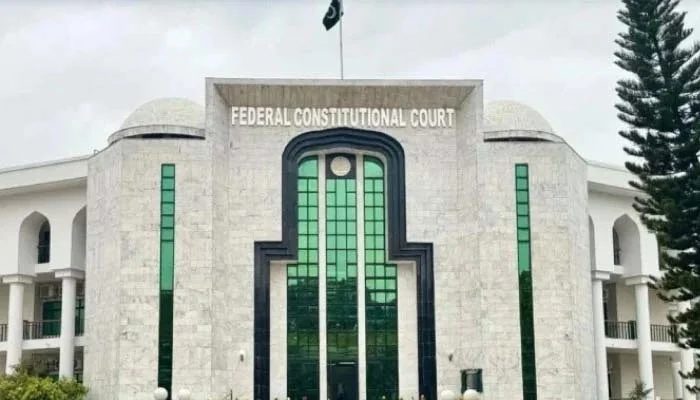
The Federal Constitutional Court (FCC) has dismissed 1,178 review petitions challenging the judgment concerning the Income Support Levy Act, 2013. A two-member FCC bench, headed by Chief Justice Amin-ud-Din Khan and comprising Justice Ali Baqar Najafi, dismissed the petitions and upheld the Supreme Court's judgment dated December 28, 2021.
The petitioners had sought a review of the ruling, which declared the Income Support Levy Act, 2013, invalid for being enacted through the Finance Act, 2013, without following the constitutionally prescribed legislative procedure. The court held that the constitutional questions raised were duly examined, and no sufficient legal ground was established for reconsideration.
"Consequently, the instant review petitions are dismissed, and the judgment dated 28.12.2021 shall remain undisturbed," the court ruled, adding that connected civil appeals are also dismissed, except for CPLA 863-L/2023, which is adjourned. The court noted that the scope of review is limited to correcting errors apparent on the face of the record.
It emphasized that legislation cannot bypass the Senate, as Articles 70 and 73 of the Constitution mandate specific procedures. The court reiterated that review power is not equivalent to an appeal, and settled disputes cannot be reopened without identifying a demonstrable error.
Meanwhile, during a hearing regarding excessive gas bills in Balochistan, the FCC requested the order sheet from the Balochistan High Court (BHC) and questioned the authority to determine gas tariffs. A two-member bench, headed by Justice Aamer Farooq, questioned whether the authority to determine tariffs rests with the Oil and Gas Regulatory Authority (OGRA).
Additionally, the court reserved its verdict on an appeal against a Peshawar High Court decision regarding CCTV cameras in prison cells, with Justice Rozi Khan noting potential privacy concerns under Article 14. The bench observed that the balance between security and individual privacy remains a critical constitutional consideration.
Finally, the court concluded hearings on the dismissal of former Pakistan Television (PTV) contract employee Tariq Nadeem, questioning the legal status of contract rights after 34 years of service. The court is expected to deliver a detailed judgment on whether long-term contractual employment grants permanent status under existing labor laws.
Legal experts suggest that the FCC's firm stance on the legislative process reinforces the supremacy of the Senate in financial matters. By rejecting the review petitions, the court has effectively closed the door on attempts to validate the 2013 levy through retrospective arguments.
The proceedings reflect the court's ongoing commitment to judicial discipline and the strict interpretation of constitutional mandates. As the FCC continues to clear its backlog, these rulings serve as a precedent for future legislative challenges involving fiscal policy.
The court's focus on procedural integrity, particularly regarding the role of the Senate, marks a significant shift in how financial legislation is scrutinized. Observers are closely watching the upcoming verdicts on the remaining cases to gauge the court's long-term impact on administrative and constitutional law.