
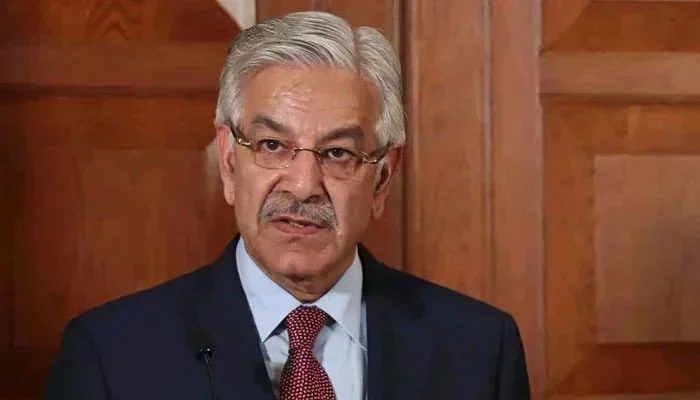
Defence Minister Khawaja Asif has criticised the practice of political victimisation, stating that governments often arrest individuals first and decide on the charges later. "When civilian governments want to arrest someone, they execute the arrest first and then contemplate what charges to bring," he said while speaking to reporters in Sialkot on Saturday.
His remarks come amid ongoing tensions between the ruling Pakistan Muslim League-Nawaz (PML-N) and the main opposition party, Pakistan Tehreek-e-Insaf (PTI), which has repeatedly accused the federal government of political victimisation, citing the imprisonment of its founder, Imran Khan, and several other party leaders.
The opposition has also criticised the imposition of emergency and governor's rule in Khyber Pakhtunkhwa on 11 October, which rendered the PTI-led provincial government non-functional. Chief Minister Sohail Afridi and several members of his cabinet were taken into 'preventive custody' following the federal government's move.
The PTI condemned the detentions as politically motivated, while the federal government maintained that the measures were necessary to address the province's worsening security situation and counter terrorism. Recalling his own political struggles, the defence minister said he had been imprisoned four times, including at Attock Fort during the era of former military ruler Pervez Musharraf.
Asif noted that he spent six months in the custody of the National Accountability Bureau (NAB) during the PTI government's tenure in 2020, adding that those who detained him could not even explain the charges against him. He further stated that he had repeatedly asked anti-graft officials what allegations had been levelled against him, asserting that political victimisation is never in the country's interest.
He said he entered politics in 1991 and has been serving the country for 36 years. The minister also mentioned his recent exchange with Jamiat Ulema-e-Islam-Fazl (JUI-F) chief Maulana Fazlur Rehman, stating he had urged him in the National Assembly to revisit his political narrative.
Regarding foreign affairs, the defence minister said Pakistan is playing a historic role in efforts to resolve the Iran-US conflict and address differences between Iran and its Arab neighbours. He added that Pakistan's diplomatic efforts under the leadership of Chief of Army Staff General Syed Asim Munir are continuing.
Asif also claimed that Pakistan had defeated an enemy five times its size during the latest conflict with India. He concluded by reiterating that the stability of the country depends on moving away from the culture of political vendettas and focusing on national development.
The minister emphasised that the current political climate requires maturity from all stakeholders to ensure that the democratic process remains uninterrupted and that the rule of law is upheld across all provinces without bias. He further noted that the government remains committed to its economic agenda despite the political noise, and that the focus must remain on providing relief to the common man while navigating the complex geopolitical landscape of the region.