
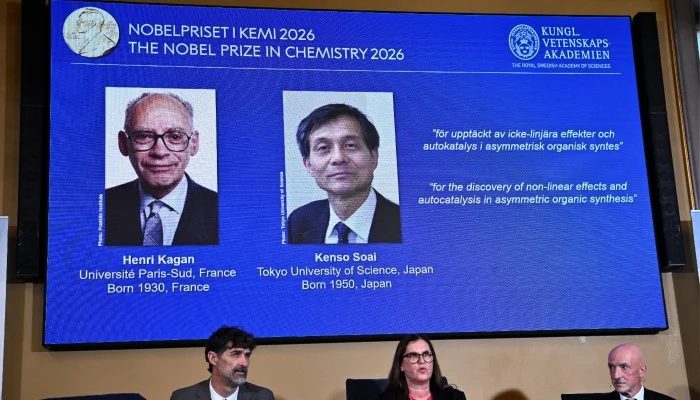
France's Henri Kagan and Japan's Kenso Soai won the Nobel chemistry prize in Stockholm on Wednesday for solving why only one version of some molecules' mirror-image forms appears in nature. The Royal Swedish Academy of Sciences honoured the pair for discovering non-linear effects and autocatalysis in asymmetric organic synthesis, a phenomenon known as homochirality.
Nobel Committee for Chemistry chair Heiner Linke stated that Kagan and Soai solved a century-old chemical mystery by enabling chemists to drive reactions leading to spontaneous homochirality. The jury noted that these spectacular discoveries have proven decisive for researchers designing reactions to manufacture pharmaceuticals.
Last year's chemistry prize went to Susumu Kitagawa, Richard Robson and Omar Yaghi, following recent announcements for the physics and medicine prizes. Winners receive a diploma, a gold medal and a shared 12-million-kronor prize sum at a formal December 10 ceremony.