
The government has officially introduced the New Energy Vehicles (NEV) Policy 2025-2030, a strategic framework designed to promote electric vehicles (EVs), encourage local manufacturing, and significantly reduce the nation's reliance on imported automotive components. During the Question Hour in the National Assembly, in a formal written reply to a query submitted by Malik Shakir Awan, it was stated that the policy proposes a substantial subsidy of Rs80,000 for the purchase of electric two-wheelers and Rs400,000 for three-wheelers to incentivize consumer adoption.
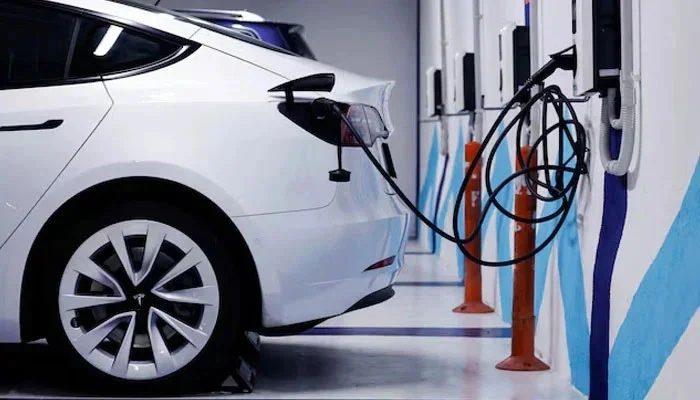
The NEV Policy envisions the establishment of 40 Level-3 fast-charging stations in the initial phase, strategically located along motorways and selected sections of the N-5 national highway. This rollout will be followed by a massive expansion to approximately 3,000 public charging facilities by 2030.
These facilities will encompass a mix of fast, Level-2, and Level-1 chargers, alongside advanced battery-swapping stations to ensure seamless travel for EV users across the country. To ensure nationwide connectivity, charging facilities are planned at approximately 50-kilometre intervals along all major highways.
Furthermore, the policy actively encourages existing fuel stations and Oil Marketing Companies (OMCs) to progressively incorporate EV charging infrastructure, effectively utilizing the existing nationwide retail fuel network to accelerate the transition to green energy. Under the NEV Policy and the Pakistan Accelerated Vehicle Electrification (PAVE) programme, the government is working to establish an integrated electric mobility ecosystem.
The Engineering Development Board (EDB) is spearheading local manufacturing efforts by requiring value-addition commitments from industry players and prioritizing the domestic production of critical components, including electric motors, battery packs, power electronics, chargers, and complex wiring systems. Separately, addressing concerns regarding public transport safety, Minister for Railways Muhammad Hanif Abbasi responded to a question by Sahibzada Sibghatullah.
The Minister reported that 349 derailments involving passenger and freight trains occurred between 2022 and September 24, 2026. According to the official report, track defects, human error, and rolling-stock failures were identified as the primary causes behind these unfortunate incidents.
In a move to modernize the aging rail infrastructure, the Minister informed the National Assembly that Pakistan Railways has finalized a comprehensive plan to phase out 418 old passenger coaches. These will be replaced by 399 modern, state-of-the-art coaches by 2030 as part of a broader fleet modernization programme aimed at improving safety and passenger comfort across the national rail network.