
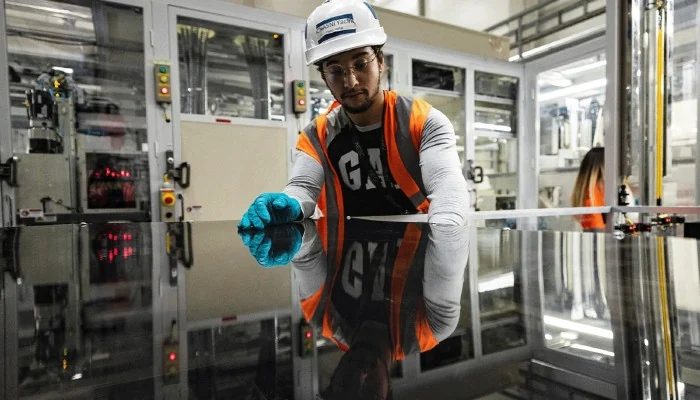
Pakistan's military-owned Margalla Heavy Industries Limited (MHIL) has signed an agreement with Chinese partners and local investors to set up a $2.25 billion lithium-ion battery manufacturing plant in Rawalpindi, an official said on Monday, with production expected to begin within months of the government approving a policy for the sector, reports Arab News.
The development comes as the South Asian country seeks to reduce its reliance on imported energy technologies and develop local manufacturing capacity amid growing demand for energy storage, electric vehicles and renewable energy. Lithium-ion batteries are central to storing electricity generated by solar and wind power and powering electric mobility, making domestic production a potential avenue for reducing import costs and attracting foreign investment.
The gigafactory's feasibility studies have been completed and the project is awaiting approval before it could start manufacturing, according to Hamad Ali Mansoor, CEO of the Engineering Development Board (EDB), an apex government body entrusted to strengthen the engineering base in Pakistan.
"The building is ready, the machines are installed, so after the policy comes, the production will start within six to eight months," Mansoor told Arab News, adding that Islamabad was working with Chinese and local stakeholders to invest in the multibillion-dollar project.
"They are investing $2.25 billion in Pakistan." Located at Heavy Industries Taxila in Rawalpindi district, MHIL manufactures defence equipment, including battle tanks, armoured vehicles, unmanned drones, protective gear, compact battery energy storage systems and EV buses and two-wheelers. Arab News reached out to MHIL's general manager for digital media, Muhammad Ameen, but he was not immediately available for comment.
The development comes days after Prime Minister Shehbaz Sharif approved the Automotive and Auto Parts Manufacturing Policy 2026-2031, which awaits International Monetary Fund (IMF) approval over proposed tax incentives for Pakistan's Electric Vehicles industry and their potential revenue implications. After the new EV-based auto policy takes effect, EDB estimates that Pakistan's demand for battery energy storage systems (BESS) could reach as much as 100,000 megawatts (MW) by June 2030.
Building a local plant to manufacture lithium-ion batteries would be crucial for the cash-strapped country, which aims to shift its petrol-powered vehicles to EVs to save billions of dollars it spends every year to import fuel. Mansoor said the battery gigafactory project was signed in July with a Chinese company he described as one of the "top-tier manufacturers in China" alongside a local private-sector investor.
He would not name the Chinese and local investors now. "They are manufacturing lithium-ion cells," he said, adding that the facility would produce lithium-ion cells having a capacity of more than 1,000MW annually.
EDB has estimated that grid stabilization alone could require 3,000-5,000MW of battery storage and that meeting the projected demand would require four to five gigafactories, each costing around $1 billion to $1.25 billion. "In our industry, we will have up to 100,000 megawatts of battery energy storage systems.
This is a very large capacity. For this, we need four to five gigafactories," the EDB CEO said, adding that the first facility would initially produce around 200-300MW before scaling up completely.