
During a week that is rocked by the imposition of emergency and the governor's rule in Khyber Pakhtunkhwa, what event or revelation or thought has disturbed you the most? Have you lost sleep over something during this time?
Or have you been too confused to decipher your own state of mind? Or do you just not care?
If you take your cue from political pundits, the big event now is the (temporary?) removal of the Pakistan Tehreek-e-Insaf (PTI)'s provincial government in KP through measures that lack democratic spirit. A detailed analysis of what this means would certainly be quite valid.
There is this surge in terrorist violence in KP and also in Balochistan. Besides, the long march that was being led by the removed chief minister Sohail Afridi had also caused massive civic disruptions.
But I am more concerned about cracks that are widening in our society, beyond politics. Here is something that could threaten the very survival of this country.
In fact, I cannot understand why our rulers are not addressing these crises, which are getting more and more vicious. Do they not see that Pakistani society is coming apart at the seams?
This has been my refrain, yes. But I will restrict myself to what has been reported in the media this week.
I regret that I don't have space to include all the headlines related to social decline and disorder. In recent years, we have fallen to the bottom of South Asia in many crucial social development indicators.
The gap now appears to be widening. Does your heart not sink when you contemplate this reality?
Perhaps the Peshawar tragedy in which at least 30 children and a female teacher were killed when the roof of a private school collapsed on Thursday does not belong in this tally. We may consider this an accident, though it also exemplifies the state of education in the country.
We talk a lot about the Constitution in the context of protecting democratic values, but what about the government's constitutional responsibility to provide free primary education to all children in the country? Will there be a long march to demand this fundamental right?
Anyhow, the Peshawar tragedy has deepened the gloom that is surrounding us. I do feel that this heartbreaking event also portrays a deprived and potentially flawed society.
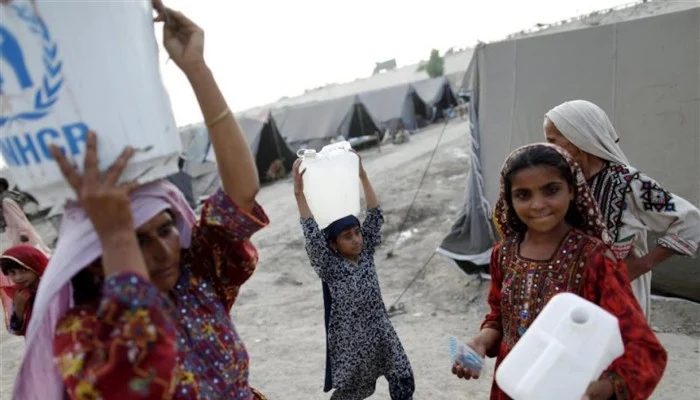
We see glimpses of growing poverty here, and this is my first reference to a headline I read in the print media on Tuesday. The United Nations Development Programme (UNDP) released the Multidimensional Poverty Index (MPI) in New York on Monday.
According to this index, 38.3% of Pakistan's population was multidimensionally poor, compared with 16.4% in India and 14.9% in Bangladesh. I ask you to read these figures again, pause and think.
The estimates are based on household surveys conducted in different years and do not provide a strictly contemporaneous comparison. What we gather, surely, is that more than one-third of Pakistan's population faces overlapping deprivations in health, education and living standards.
The intensity of deprivation among those classified as multidimensionally poor stood at 51.7% in Pakistan. Another 12.5% of the population was considered vulnerable to multidimensional poverty, indicating that a substantial share of the people remained at risk of falling into acute deprivation.
We have plenty of material in UNDP's MPI report, but I am moving on to another assessment from the World Economic Forum's annual meeting of Global Future Leaders.