
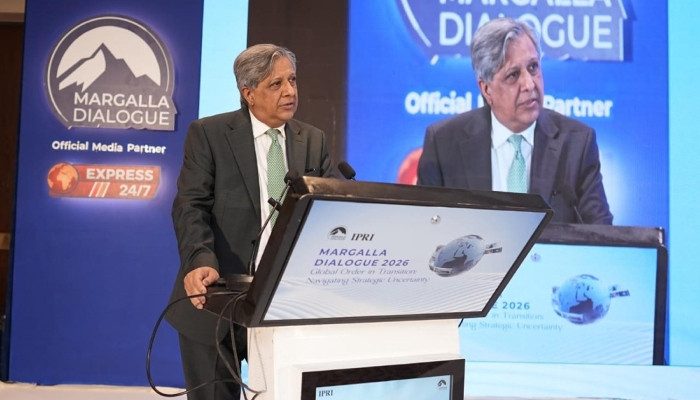
Federal Minister for Law and Justice Azam Nazeer Tarar said that adherence to international law, treaties, and established global norms is essential for lasting peace in South Asia. Given the shared history, geography, and sensitivities between Pakistan and India, he said, it is imperative that both countries address their disputes through international agreements and established mechanisms available under the United Nations and other multilateral institutions.
Delivering the keynote address at the Margalla Dialogue on Wednesday, the minister said that during the recent escalation, Pakistan had offered to facilitate an independent investigation into the incident by any country or agency in the world. Instead of pursuing this offer and using available diplomatic and legal mechanisms, he said, the path of military aggression was chosen by the other side.
Tarar stressed that resolving disputes through international law and established multilateral forums could help prevent conflict and its devastating consequences for the region. He said that when states disregard the rule of law and established international mechanisms, people on both sides ultimately bear the heavy consequences of such actions.
"The rule of law, at both domestic and international levels, remains the foundation for a fair and sustainable resolution of disputes," he noted during his detailed address. Describing the Indus Waters Treaty as a unique and successful instrument in the history of international agreements, he said that facilitated by the World Bank, the treaty had remained in force for more than six decades despite wars and periods of tension between Pakistan and India.
"It provides a structured framework for the distribution of water resources, exchange of information, and resolution of disputes through mechanisms including the Permanent Indus Commission, a Neutral Expert, and a Court of Arbitration," he added. He reiterated that the treaty does not provide for its unilateral termination and requires the mutual consent of both participating parties.
Referring to Pakistan's legal objections to India's announcement of the unilateral suspension of the treaty, Tarar said that disregarding the rights of a lower riparian state was contrary to the spirit of the treaty and fundamental principles of international law. He observed that states have two broad choices in resolving disputes: the use of force, or settlement through law, dialogue, and institutional mechanisms.
In the modern era, he said, the use of force carries grave and long-lasting consequences for regional stability and economic development. "Diplomacy, engagement, and international legal frameworks should therefore be prioritised," he added, emphasizing peaceful coexistence.
The senator expressed the hope that all countries in the region would resort to international law and available multilateral mechanisms to resolve their longstanding disputes, warning that the consequences of any major conflict could be devastating for people living on both sides of the border.