
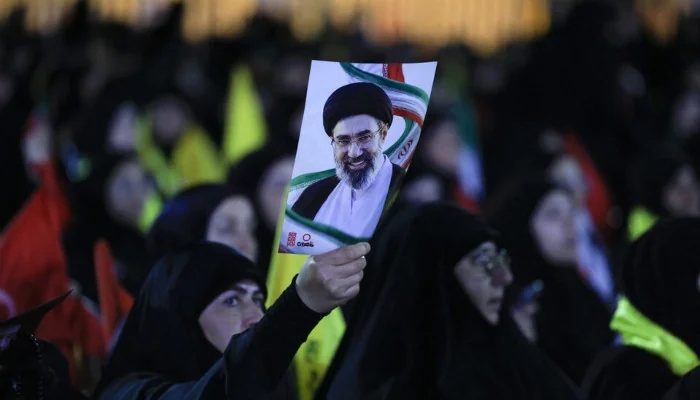
More than eight months after an Israeli strike killed Ayatollah Ali Khamenei's family, Iran operates without a visible supreme leader.
- Mojtaba Khamenei formally rules in his father's place but remains underground.
- A six-man security council now dominates decision-making across the Iranian state.
- The economy contracted by ten percent in the second quarter compared to 2025.
Mojtaba Khamenei remains hidden
Mojtaba Khamenei survived the opening-day strike of the US-Israeli war and formally rules in his father's place. Iranian officials and Western intelligence agencies insist he remains alive and underground for fear of assassination. His silence, officials concede privately, is deafening. Even if active, Mojtaba would need time to consolidate power given lingering opposition to dynastic succession and his limited religious credentials.
In his absence, the Islamic Republic's clerical imprint has grown visibly lighter. A pop star sentenced in absentia for incorporating Quranic verses into his songs returned from abroad. Adherence to the veil is slipping, some Tehran restaurants serve French wine, and Halloween was publicly celebrated in the capital.
Six-man council wields power
The most important shift is in how power is wielded across the country. Sanam Vakil of Chatham House stated that what principally changed is that there is no clear, final arbiter. Appointments to the state broadcaster, ministries and judiciary were once subject to approval by the supreme leader office. Today the executive has a freer hand, and an Iranian academic in Tehran quipped that Israel did Iranians a favour getting rid of Khamenei.
Decision-making is now dominated by six men from the Supreme National Security Council, which is a 13-member body of generals and bureaucrats. President Masoud Pezeshkian, one of the six, told CBS that the group reaches decisions through coordination. The others include Major General Ahmad Vahidi, commander-in-chief of the Islamic Revolutionary Guard Corps, and Mohsen Rezaei, the council secretary and former IRGC chief. The group also includes Mohammad Bagher Qalibaf, the speaker of parliament and former IRGC brigadier general, along with Ali Abdollahi, chief of the general staff of the armed forces, and Foreign Minister Abbas Araghchi as the only other civilian.
The biggest decisions require the collective consent of this group. This includes negotiations on ending or restarting the war with America, nuclear policy, and the appointment of a non-cleric as intelligence minister for the first time in decades. Each member also holds a degree of autonomy. Rezaei serves as a stalwart of the system, Vahidi keeps order in the IRGC ranks, and Qalibaf runs parliament affairs. Pezeshkian is left to manage a war-induced depression and a currency in near freefall. The economy contracted by 10 percent in the second quarter compared with the same period in 2025, though Pezeshkian appears to manage the fallout better than expected while keeping the lights on despite the bombing of some oil refineries and power plants.
Domestic control and war strategy
Not all senior officials fit neatly under the six-man committee command. Domestic control remains largely in the hands of Hossein