
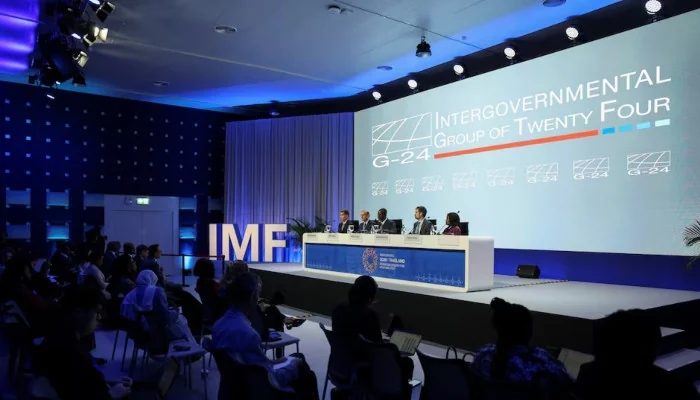
Pakistan has assumed the chairmanship of the Intergovernmental Group of Twenty-Four (G-24), reiterating its pledge to strengthen the collective voice of developing economies and advance a fair, development-oriented international financial system, the finance ministry said on Sunday. Finance Minister Muhammad Aurangzeb described the chairmanship as a profound responsibility, calling for renewed international cooperation, stronger multilateral institutions, and reinforced global commitments to address climate shocks, development financing gaps, and global economic fragmentation.
"The future of developing economies is not peripheral to the future of the global economy; it is central to it," Aurangzeb said, highlighting the immense potential of emerging nations as drivers of investment, innovation, and global growth. The finance minister outlined three priorities: development-led growth, stronger representation for developing economies, and reform of the international financial architecture.
Aurangzeb stated that Pakistan, as the G-24 chair, will prioritize placing development at the center of global economic policymaking. He stressed that macroeconomic stability must serve as a foundation for investment, productivity, and shared prosperity, enabling low-income economies to move beyond crisis management toward sustainable growth.
Furthermore, he advocated for more equitable governance and meaningful participation in decision-making within Bretton Woods institutions to meet the evolving needs of their members. Pakistan's third priority involves advancing a development-oriented financial architecture, including affordable financing, sustainable debt solutions, and greater mobilization of capital.
"Our task is to ensure that the immense potential of developing economies is not constrained by an international financial architecture that has yet to fully adapt to a changing world," he emphasized. Drawing on Pakistan's experience with stabilization, the minister underscored the importance of aligning financial stability with long-term development objectives.
He reaffirmed that Pakistan's chairmanship would be guided by the principles of consensus and collective advocacy, working closely with members across Africa, Asia, and Latin America, alongside the International Monetary Fund (IMF) and World Bank, to translate shared priorities into practical outcomes.
Senator Aurangzeb also acknowledged Nigeria's leadership as the outgoing chair, stressing that the effectiveness of collective leadership must be judged by tangible development outcomes. The G-24 was established in 1971 to coordinate the positions of developing countries on international monetary and development finance issues.
Pakistan's leadership comes at a critical juncture as global markets face inflationary pressures and debt sustainability challenges. The ministry confirmed that Pakistan will host several high-level meetings throughout its tenure to foster dialogue among member states.
These sessions aim to build a unified stance ahead of the annual meetings of the IMF and World Bank. As chair, Pakistan intends to leverage its position to advocate for climate-resilient infrastructure funding.
This focus aligns with the country's own recent experiences with climate-induced disasters and the subsequent need for global financial support mechanisms. The government remains committed to ensuring that the G-24 platform serves as a catalyst for meaningful policy shifts.
By fostering collaboration, Pakistan hopes to bridge the gap between the Global North and the Global South, ensuring that the voices of emerging economies are heard in the corridors of power.