
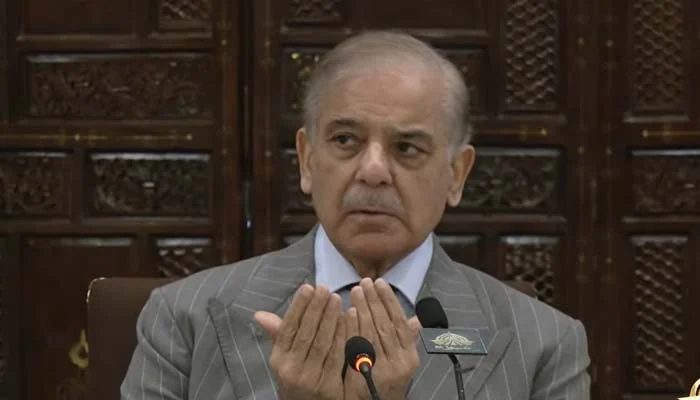
Prime Minister Shehbaz Sharif on Thursday said the imposition of governor's rule and an emergency in Khyber Pakhtunkhwa (KP) had been undertaken "under extreme compulsion" as he addressed a meeting of the provincial apex committee in Peshawar to review the security situation.
The prime minister arrived in Peshawar earlier in the day for his first visit to the province since governor's rule and the emergency were imposed on 11 October. Chief of Army Staff (COAS) General Asim Munir, KP Governor Faisal Karim Kundi, federal ministers, and newly appointed provincial advisers attended the high-level meeting.
Addressing the participants, PM Shehbaz Sharif explicitly blamed the Pakistan Tehreek-e-Insaf (PTI) for the deteriorating security landscape in the province, alleging that the previous provincial administration failed to address the rising tide of militancy. The prime minister described Khyber Pakhtunkhwa as a very beautiful province and expressed hope that the current administration would work to accelerate its development.
He emphasized that the federal government is committed to restoring peace and stability in the region, which he termed essential for the economic uplift of the local population. "I hope we work hard day and night and speedily make progress towards development and prosperity," he said.
He further stated that the federal government would provide all necessary resources to the provincial authorities to ensure that the rule of law is maintained and that the citizens of the province can live without fear. The meeting also reviewed the ongoing security operations against militant groups.
General Asim Munir briefed the committee on the operational readiness of the security forces and the challenges faced in border management. The participants agreed on a unified strategy to counter the threats posed by non-state actors.
Political analysts suggest that the prime minister's visit is a strategic move to consolidate federal control and signal a shift in the governance approach in the province. The imposition of emergency measures has been a point of contention between the federal government and the opposition, with the latter terming it an undemocratic move.
However, the federal government maintains that the decision was necessary to prevent a total collapse of law and order. The provincial advisers, who have been tasked with overseeing administrative affairs, are expected to work closely with the governor to streamline public services.
The prime minister also held separate meetings with local elders and representatives to listen to their grievances. He assured them that the federal government would prioritize the resolution of issues related to infrastructure, education, and healthcare in the province.
As the situation remains fluid, the government has directed law enforcement agencies to remain on high alert. Further policy announcements regarding the duration of the emergency are expected in the coming weeks as the security situation is monitored closely.
This is a developing story and is being updated with more details as official statements are released by the Prime Minister's Office and the provincial government.