
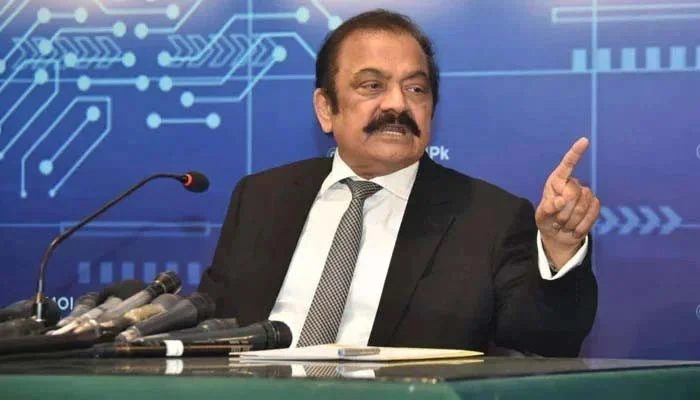
Adviser to the Prime Minister on Political Affairs Rana Sanaullah said on Friday that political parties that do not join the national agenda to eliminate terrorism will be 'minus,' stressing that the entire nation must unite against this menace. Sanaullah made these remarks while responding to a question, reiterating that those who do not support the anti-terrorism agenda will be sidelined.
His remarks come a day after Prime Minister Shehbaz Sharif chaired a federal apex committee meeting in Peshawar to review the security situation. The prime minister arrived in Peshawar for his first visit to the province since the imposition of governor's rule on October 11.
Chief of Army Staff (COAS) General Asim Munir, Khyber Pakhtunkhwa (KP) Governor Faisal Karim Kundi, federal ministers, and newly appointed provincial advisers attended the meeting. Addressing the participants, the prime minister lashed out at the Pakistan Tehreek-e-Insaf (PTI) over the worsening security situation, noting that the province had been a 'cradle of peace' just a few years ago.
He vowed that the federal government, currently overseeing Khyber Pakhtunkhwa under governor's rule, would make every possible effort to restore progress. The Pakistan Muslim League-Nawaz (PML-N) leader added that Governor Kundi had requested Rs160 billion, which Prime Minister Shehbaz Sharif approved immediately.
Responding to a question about the proposed 28th Constitutional Amendment, Sanaullah stated that no discussions had taken place on the matter, and no draft had been presented. The political climate in the country remains tense as the government seeks a unified front against rising militancy.
Sanaullah emphasized that national security transcends partisan politics and that the state is committed to purging the country of extremist elements. The federal government's decision to impose governor's rule in Khyber Pakhtunkhwa has sparked significant debate, with the opposition accusing the center of overstepping its constitutional authority.
However, the government maintains that the move was necessary to stabilize the region. Security analysts suggest that the upcoming weeks will be critical in determining whether the government can successfully build a consensus on its security policies.
The role of the provincial administration under the new setup will be closely monitored by both the public and political stakeholders. As the situation develops, the government continues to urge all political factions to prioritize national stability over political gains.
The focus remains on the implementation of the security roadmap discussed during the apex committee meeting. The government's commitment to providing financial resources, as evidenced by the approval of the Rs160 billion package, reflects its intent to address the developmental and security gaps in the province.