
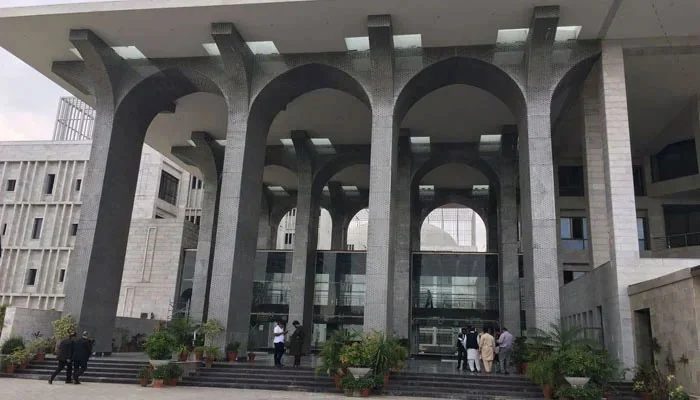
The Islamabad High Court (IHC) on Tuesday disposed of petitions challenging the detention of four individuals, including two Pakistan Tehreek-e-Insaf (PTI) lawmakers and a Pakistan Muslim League-Nawaz (PML-N) worker, under the Maintenance of Public Order (MPO) law, declaring the pleas infructuous. In its written judgment, Justice Khadim Hussain Soomro clarified that the disposal of petitions did not mean the court had declared any unlawful detention to be constitutional or legal.
The petitions challenged detention orders issued against Adil Bazai, Dawar Kundi, Khushdil Khan, and Basharatullah under Section 3 of the MPO. The court expressed no opinion on the legality of subsequent detention orders issued on 3 October 2026, as those orders had not been challenged before the court.
The judgment stated that the legality of the subsequent detention orders could not be determined without a specific challenge to them. Emphasizing the limits on preventive detention, the court observed that this extraordinary power could not be exercised arbitrarily and had to remain within the bounds prescribed by the Constitution and relevant law.
The court further highlighted that the state must ensure that all preventive measures align with fundamental rights. The judgment noted that informing a detainee of the grounds for detention within 15 days is a mandatory constitutional requirement that cannot be bypassed by administrative authorities.
Legal experts suggest that this ruling serves as a reminder to the executive branch regarding the misuse of the MPO. The court's stance reinforces the principle that preventive detention is an exceptional measure, not a tool for political suppression or silencing dissent.
The petitioners had argued that their detention was politically motivated and lacked sufficient evidence to justify the threat to public order. While the court disposed of the current petitions due to the expiry of the initial orders, the observations made by the bench provide a legal framework for future challenges.
Justice Soomro's remarks underscore the judiciary's role in safeguarding individual liberties against state overreach. The court maintained that while the state has the authority to maintain order, it must do so through transparent and legally sound procedures.
The case highlights the ongoing tension between state security measures and the protection of civil liberties in Pakistan. The IHC has consistently signaled that it will scrutinize detention orders that appear to lack a solid factual basis.
As the legal proceedings conclude for this specific case, the focus now shifts to whether the authorities will adhere to these judicial observations in future detention cases. The court's written order is expected to be cited in upcoming litigation involving similar MPO-related detentions.
The IHC remains committed to upholding the rule of law, ensuring that the executive branch operates within the constitutional framework, and protecting citizens from arbitrary deprivation of their freedom.