
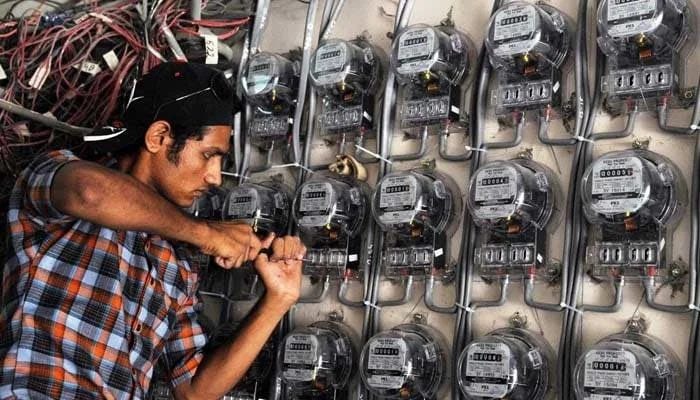
The Senate was informed on Tuesday that the government had decided to abolish the electricity slab system that punished consumers for crossing the 200-unit threshold even by one unit. Speaking in the House, Minister for Energy Awais Ahmad Khan Leghari said only the poor segment of society would be entitled to targeted subsidies.
He was responding to a calling-attention notice moved by Pakistan Muslim League-Nawaz (PML-N) Senator Abid Sher Ali regarding tariffs charged by distribution companies and the financial burden on consumers. Leghari explained that work was being expedited to abolish the system under which a consumer crossing 200 units had to pay a much higher cost and remained ineligible for relief for the next six months.
Abid Sher Ali pointed out that when monthly consumption increased from 200 to 201 units, the tariff jumped from Rs15 to Rs30 per unit, forcing a poor consumer to pay bills under the 400-unit slab for just one extra unit. "This cruel slab system effectively punishes the poor and drains the common man for months," he lamented.
The minister acknowledged it as a genuine problem and said the ministry was seriously working to abolish the six-month bar. Leghari said two options were under consideration: raising the threshold from 200 to 250 units and allowing consumers to get the protected category benefit for the month in which they restrict consumption to 200 units, abolishing the six-month penalty; he added that it would take one and a half months to finalize the plan.
The minister also noted that the number of protected consumers had increased from 10 million to 20-25 million during the last two years due to the use of solar energy, and many of them were not poor. However, he added, the new mechanism would restrict subsidies to those living below the poverty line and lower-middle-income groups.
Regarding the power sector's financial situation, he noted that circular debt had declined to Rs1.6-1.67 trillion and was no longer increasing every year. He added that the government had set a target to eliminate it in the next four years under the reprofiling of the financing scheme, and the debt servicing surcharge of Rs3.23 per unit would also be abolished during the same period.
He acknowledged that since consumers did not bear the losses of companies and it was the finance ministry that bore the burden, the benefit of reduced losses had not yet been passed on to consumers. Meanwhile, during the Question Hour, the House was informed that the government was implementing a national Artificial Intelligence (AI) ecosystem, encompassing AI infrastructure, human capital, research, startups, financing, and responsible AI governance.
Minister for Parliamentary Affairs Tariq Fazal Chaudhry said the government had announced one billion dollars in investment for Pakistan's AI ecosystem by 2030. Responding to a supplementary question, Deputy Prime Minister Ishaq Dar informed the House that Pakistan had joined the World AI Cooperation Organization, a China-led initiative aimed at promoting transparency, openness, and cooperation in artificial intelligence.