
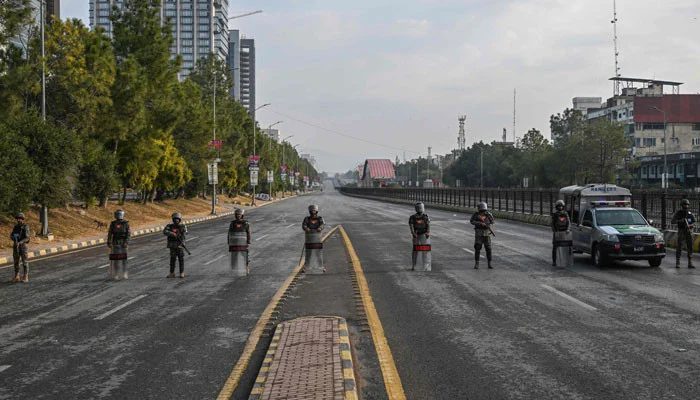
Following the imposition of an emergency in Khyber Pakhtunkhwa under the governor, and the provincial chief minister and his cabinet being rendered ineffective via a presidential order by President Asif Ali Zardari, the situation in the provincial capital and across the province remained tense but peaceful on Sunday.
A 12-member advisory council has been named, including Lieutenant General (retd) Nigar Johar and MNA Samar Haroon Bilour, to assist the governor in provincial affairs. Several senior officials have been transferred and directed to report to the Establishment Division.
Roads leading to the Red Zone and cantonment areas in Peshawar remained sealed since early Sunday to prevent unrest. Containers and concrete blocks were placed at key points, including Firdous on GT Road, Gora Qabristan on University Road, Stadium Chowk in Saddar, Civil Quarters, Swati Phatak, and Michni Gate.
Police diverted traffic to alternate routes, and heavy contingents were deployed across the province. Cellular and Wi-Fi networks remained suspended throughout Sunday.
Sources confirmed that raids were conducted on the residences and hujras of Pakistan Tehreek-e-Insaf (PTI) ministers and lawmakers. PTI legislators stated their security was withdrawn late Saturday, warning that the Inspector General of Police (IGP) would be held responsible for any untoward incident.
KP Information Minister Shafi Jan confirmed the security withdrawal, prompting KP Assembly Speaker Babar Saleem Swati to write to the IGP, demanding the immediate redeployment of security for ministers and MPAs. A separate administrative setup has also been announced for the erstwhile FATA and southern districts to ensure governance.
Police have been issued strict guidelines to protect public and private property, with instructions to record video evidence of any vandalism for future prosecution. Meanwhile, Awami National Party chief Aimal Wali Khan criticized the developments, stating that neither emergency nor governor's rule are solutions to the province's problems.
The political climate remains volatile as the federal government seeks to stabilize the region. Observers note that the suspension of communication services has further isolated the provincial capital, causing significant inconvenience to the general public.
The advisory council is expected to meet shortly to outline the immediate priorities for the province, focusing on law and order and the restoration of essential services. As the situation unfolds, the provincial administration is under immense pressure to maintain stability.
The deployment of additional police forces in sensitive areas is intended to deter any potential protests or civil disobedience. Political analysts suggest that the coming days will be critical in determining the long-term impact of these administrative changes on the political landscape of Khyber Pakhtunkhwa.