
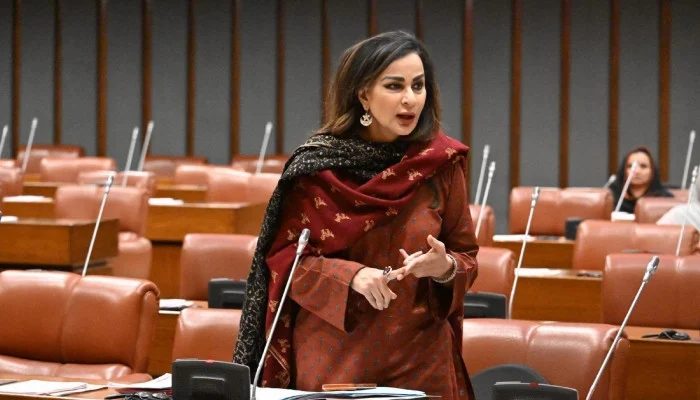
Lawmakers in the Senate on Friday expressed deep concern over the looming energy crisis in the country against the backdrop of the regional situation and called on the government to brief the House on its contingency plan. On a point of public importance, Pakistan Peoples Party (PPP) Senator Sherry Rehman expressed concern over the evolving situation in West Asia and said the regional conflict and reports of renewed attacks on Iran had added to uncertainty over Pakistan's petroleum supplies.
"Members across the House are asking a very fundamental question: Will Pakistan have adequate petroleum supplies under the current circumstances? These are not minor concerns.
They have direct implications for the country's energy security, economic stability, and the lives of ordinary citizens," she said. She pointed out that Pakistan had received five LPG cargoes last year, whereas only two cargoes were coming this year on spot booking, raising further questions about supply planning at a time of heightened regional uncertainty.
"This is an extremely serious matter. Pakistan relies on imports for nearly 70% of its LPG requirements, while domestic production accounts for the remaining 30%.
And will petrol and other petroleum products be available until December? Will there be rationing, or how will these be available?" she contended.
While there was likely to be a shortage of these products, she emphasised, the government needed to explain its plan in this connection. Therefore, the ministers of petroleum and power should brief the House on Monday or Tuesday.
She underlined that Parliament must be kept informed, particularly when developments in the region could have direct consequences for Pakistan. Senator Sherry questioned the utilisation of the carbon levy, demanding transparency in its collection and expenditure, while also raising serious concerns over Pakistan's petroleum supply amid escalating tensions in West Asia.
"Yesterday, during the meeting of the Senate Standing Committee on Climate Change, the additional secretary for finance acknowledged that the carbon levy is not being spent on environmental projects. A levy is not a tax; it goes straight into the Federal Consolidated Fund, where there is no ring-fencing for spending on climate action," she said.
Senator Sherry pointed out that Pakistan continued to face severe and devastating floods. She questioned the rationale for collecting a carbon levy in a country increasingly exposed to climate-induced disasters if the proceeds were not transparently directed towards environmental protection and resilience-building.
"The federal government continues to collect this revenue through the petroleum levy, and the money goes into the Federal Consolidated Fund. It cuts across all the provinces.
There should not be a carbon levy in the next budget unless it is restructured as a carbon tax that is ring-fenced for mitigation and climate action. There has to be accountability for every rupee collected," she said.
Taking the floor, Leader of the Opposition in the House Allama Raja Nasir Abbas noted that areas from Iran to Yemen were in the grip of war, with Bab al-Mandab and the Strait of Hormuz located in the region. He insisted that the war in Yemen was very dangerous and said while requests were being made for Pakistan's intervention there, Islamabad should instead mediate between Saudi Arabia and Yemen.