
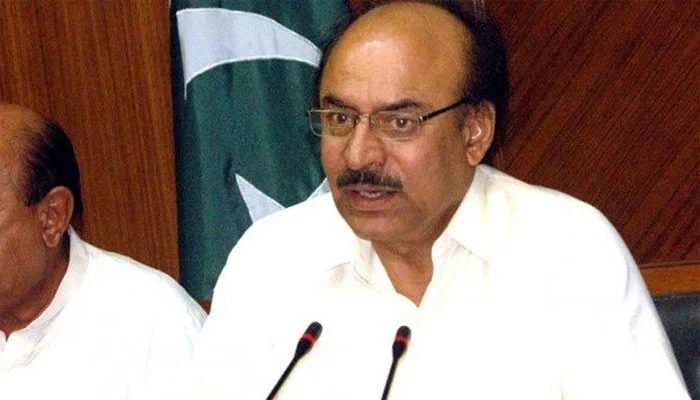
Sindh Pakistan Peoples Party (PPP) President Nisar Khuhro has questioned the rationale behind calls for creating new administrative units in Sindh, stating that those advocating the proposal do not appear to understand what such units would represent, as the province already has an administrative structure based on divisions.
Addressing a press conference in Karachi on Friday, he said demands for new provinces and administrative units were being raised to create political upheaval. He reiterated that Sindh did not want a new province or any alteration to its existing boundaries, pointing out that the Sindh Assembly had unanimously adopted a resolution rejecting such proposals.
He said the Constitution clearly laid down the procedure for creating new provinces, explaining that a province could not be established unless the assembly of the province concerned passed a resolution in favour of the proposal with a two-thirds majority. He added that if new provinces were to be created, the assemblies of Punjab and Gilgit-Baltistan could consider such proposals if they wished to do so.
Commenting on the proposed 28th Constitutional Amendment, Khuhro said it was premature to discuss the matter, arguing that the federal government did not have the required two-thirds majority in the National Assembly to secure its passage. He maintained that even if the federal government brought all its coalition partners together, it would still fall short of the numbers required to pass the proposed amendment.
He cautioned that the debate surrounding the 28th Amendment could weaken the country's future. Turning to the situation in Khyber Pakhtunkhwa, Khuhro said President Asif Ali Zardari had signed a summary for the imposition of governor's rule in the province on the advice of the prime minister.
He observed that governor's rule had been imposed in Pakistan on several occasions, adding that the first such arrangement in Sindh was introduced in 1951. He also said that former military ruler General Ziaul Haq had imposed governor's rule specifically in Sindh.
Khuhro said the Constitution permitted the imposition of governor's rule when the situation in a province deteriorated beyond acceptable limits. He maintained that the security crisis in Khyber Pakhtunkhwa was not a recent development but had persisted for years.
He alleged that during former prime minister Imran Khan's government, members of the Tehreek-e-Taliban Pakistan (TTP) had been released from prisons in Afghanistan and brought back to Pakistan to settle here. He further alleged that the previous government had entered into agreements and held negotiations with the Afghan Taliban.
Khuhro also claimed that the Khyber Pakhtunkhwa chief minister had not demonstrated a willingness to confront terrorists. The PPP leader said, however, that the federal government had not closed the door to negotiations with political parties over the situation in the province.
He stressed that governor's rule in Khyber Pakhtunkhwa was not intended to be permanent and could be withdrawn if political parties reached a consensus on a joint strategy to combat terrorism. The PPP leader concluded by emphasizing that national stability depends on adherence to constitutional norms.
He urged all political stakeholders to prioritize the integrity of the federation over parochial interests, warning that any attempt to bypass the constitutional process regarding provincial boundaries would be met with stiff resistance from the people of Sindh. He further noted that the current economic challenges facing the country require a unified approach rather than divisive rhetoric.
Khuhro's remarks reflect the party's long-standing stance on provincial autonomy and the sanctity of the 18th Amendment, which remains a cornerstone of the PPP's political platform in the current legislative climate. In response to questions regarding the opposition's stance, he stated that the PPP remains committed to democratic dialogue but will not compromise on the fundamental rights of the provinces as enshrined in the Constitution of Pakistan.