
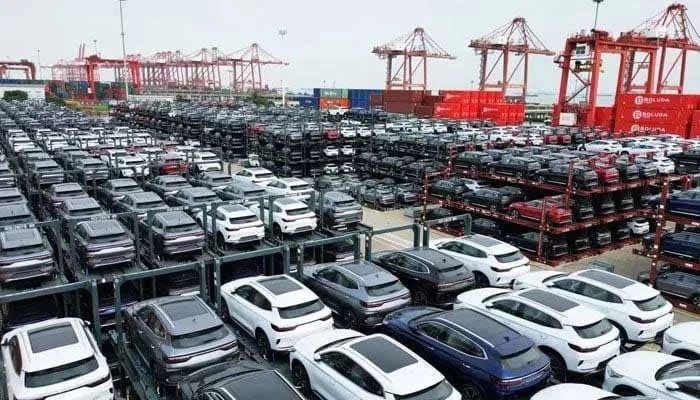
Imports of new and used completely built-up (CBU) cars surged in September 2026, raising concerns among local auto parts manufacturers over the loss of business, production scale and jobs. Industry data show that imports of new CBU cars jumped more than sixfold to 2,407 units in September from 391 in August, while used car imports more than doubled to 2,454 from 1,185.
Combined imports reached 4,861 units during the month. Among new vehicles, imports of the BYD ATTO exceeded 1,500 units, marking the model's highest monthly import volume to date.
Imports of used luxury vehicles also increased, alongside compact and mini cars, particularly the Suzuki Alto, Daihatsu Mira and Toyota Yaris. Chairperson of the Pakistan Association of Automotive Parts & Accessories Manufacturers (PAPAAM) Abdur Rehman Aizaz warned that the growing influx of imported vehicles threatened a domestic industry comprising around 1,200 auto parts manufacturers.
He said Pakistan's manufacturers produce a wide range of components, including seats, glass, doors, bumpers, headlamps, wiring harnesses, tyres, steering wheels and shock absorbers. Their capabilities are reflected in the localisation levels of some models, with locally manufactured parts accounting for as much as 65 per cent of the value of components used in the Toyota Corolla, according to Aizaz.
Unlike locally assembled vehicles, CBU cars arrive fully built without incorporating domestically manufactured components. Aizaz said every imported vehicle therefore represents a potential loss of business for local parts manufacturers, reducing production volumes and weakening the economies of scale needed to keep manufacturing costs competitive.
The industry estimates that locally manufactured parts account for approximately Rs1.5 million of the value of each locally assembled car. Applying this estimate to September's 4,861 CBU imports puts the potential value of domestic parts demand displaced by these vehicles at around Rs7.3 billion.
This is an industry estimate of potential displaced demand, rather than a confirmed loss of revenue. The actual impact will depend on the imported models and the extent to which their purchases would otherwise have supported local assembly and parts production.
Aizaz acknowledged that used car imports could offer consumers a wider choice of vehicles at competitive prices, particularly buyers able to afford cars costing around Rs5 million. However, he argued that these benefits should be weighed against the impact on employment across the automotive supply chain, from raw material suppliers and component manufacturers to vehicle assemblers.
Lower production volumes can push up per-unit costs, weaken manufacturers' competitiveness and discourage investment in machinery, technology and capacity. The consequences can extend beyond parts factories to suppliers of steel, plastics, rubber, glass and electrical components.
Questioning the priorities guiding import policy, Aizaz asked whether policymakers should give greater weight to an upper-middle-class buyer seeking an imported used car or a factory worker earning Rs40,000 a month. His remarks highlight the challenge facing policymakers: balancing consumer choice and access to imported vehicles against the need to sustain domestic manufacturing, investment and employment, while ensuring sustainable long-term economic growth.