
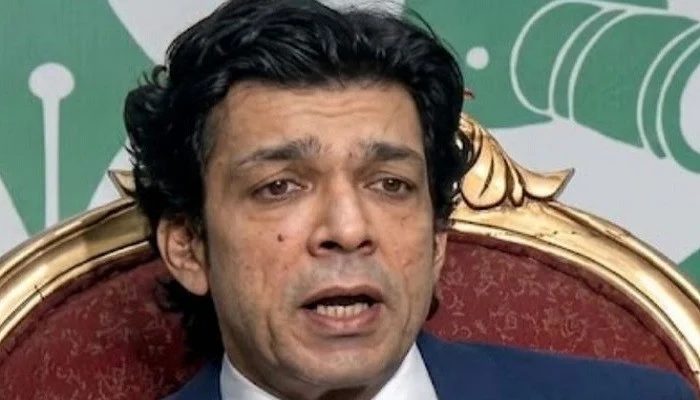
Senator Faisal Vawda has stated that he does not expect the governor's rule and the state of emergency imposed in Khyber Pakhtunkhwa to be lifted within the next 90 or even 180 days, suggesting the extraordinary administrative arrangement could remain in place for an extended period.
Speaking on the prevailing political situation, the senator said: "This is part one. Parts two and three will also come." However, Vawda clarified that he did not foresee the imposition of any further governor's rule, martial law, or a presidential system.
He also suggested that if Jamiat Ulema-e-Islam-Fazl (JUI-F) chief Maulana Fazlur Rehman had reservations, the government should address them. Vawda asserted that the country had now embarked on a path towards "positive democracy."
Regarding his election to the Senate, Vawda noted that the Pakistan Peoples Party (PPP) and Muttahida Qaumi Movement-Pakistan (MQM-P) had voted for him, while the Pakistan Muslim League-Nawaz (PML-N) had not. "I have no connection with them whatsoever," he said, referring to the PML-N.
The senator also claimed that the Pakistan Tehreek-e-Insaf (PTI) founder had gone "100% further" in his politics than the MQM founder. Khyber Pakhtunkhwa entered a new administrative setup last week after President Asif Ali Zardari imposed an emergency and governor's rule, effectively sidelining the PTI-led provincial government.
The president approved the summary on the advice of Prime Minister Shehbaz Sharif under Articles 232 and 234 of the Constitution, following recommendations by the federal cabinet and reports on the province's law-and-order situation. Under the new arrangement, Governor Faisal Karim Kundi exercises the provincial government's functions on behalf of the federation, with the assistance of an 11-member advisory council, while Parliament exercises the provincial assembly's legislative powers.
The presidential proclamation states that the chief minister, provincial ministers, advisers, special assistants, and advocate general cease to hold office. The provincial assembly, however, has not been dissolved, and political observers are closely monitoring the unfolding developments across the country.