
The recent change of government in Khyber Pakhtunkhwa raises a crucial question for anyone interested in Pakistan's politics and society: why did the removal of a popular Pakistan Tehreek-e-Insaf government produce so little visible resistance? Many analysts expected a strong reaction in the party's provincial stronghold.
Pakistan Tehreek-e-Insaf (PTI)-backed candidates had won an overwhelming share of seats in KP, and subsequent Gallup surveys continued to indicate the party's enduring popularity. Some expected voters to take to the streets, while others anticipated bureaucratic hurdles, including resignations, ministers refusing to hand over power, confrontation between provincial police and federal forces, and a transition requiring a heavy-handed crackdown.
While there have been minor reports of protests and arrests in Khyber - worryingly including the chief minister and other political figures - the larger transition appeared considerably smoother than many had predicted. There was no widespread uprising of the kind that some Pakistan Tehreek-e-Insaf (PTI) voices had warned would follow the crossing of a red line.
This article is not an assessment of the legality or morality of the emergency. The question here is analytical: why did the change happen with comparatively little visible resistance, and what does that tell us about politics and public attitudes?
Immediately after the proclamation, Gallup Pakistan conducted a snap poll nationally and in KP. The findings suggested a divided public, with substantial support for and opposition to the emergency, and a significant number of respondents unwilling to take a position.
On the question of how to respond, around 80% nationally, in KP, and within Pakistan Tehreek-e-Insaf (PTI) circles favoured a legal route over street protests. In other words, the data pointed to a limited appetite for agitation.
This gap between expectation and reality can be understood through several key factors. First, resentment, disappointment, and discontent do not automatically translate into political action.
Individuals, neighbourhoods, and biradaris can all be dissatisfied, but translating that sentiment into a collective action capable of producing an outcome requires robust organisational machinery. This is precisely why political parties and organisations exist.
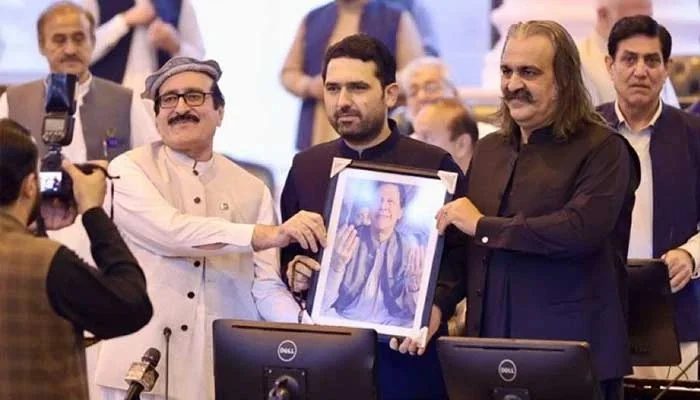
Without Imran Khan at the helm, Pakistan Tehreek-e-Insaf (PTI) has struggled to act as a cohesive political unit. Critics argue that despite its initial appeal as an iconoclastic force challenging dynastic politics, Pakistan Tehreek-e-Insaf (PTI) has become even more dependent on a single individual than the parties it opposed.
Much of its vote bank is tied personally to Khan. Other party leaders, including provincial chief ministers, command little independent political loyalty or appeal, leaving virtually no incentive for the public to rally behind them.
Mobilisation depends heavily on leadership resonance. A call to defend Imran Khan directly carries a vastly different weight than a call to defend an individual provincial leader.
If the party's political figures cannot persuade voters that their displacement is equivalent to an attack on Khan, translating his personal popularity into sustained street agitation becomes exceedingly difficult. Ultimately, this episode demonstrates that raw popularity does not automatically guard a government unless well-oiled party mechanics are fully operational.