
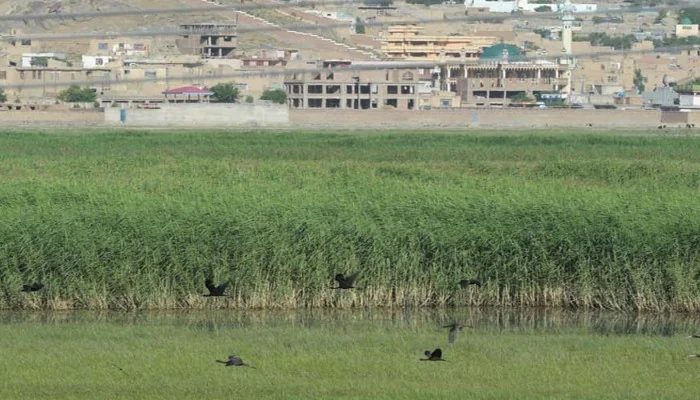
Who has the legal right to the 312,440-acre Shikargah, the former Bahawalpur royal hunting ground estimated by the Cholistan Development Authority to be worth Rs555 billion? The Punjab government maintains that the land was resumed under land reforms, while the former Ameer's 23 legal heirs and subsequent purchasers base their claims on a government-led distribution process.
At the centre of the decades-old dispute is a handwritten insertion of a single word, "entire", in a government order issued in 2003. While the state maintains that the land belongs to the government, those claiming rights over it rely on subsequent administrative decisions and mutation records.
The competing claims raise fundamental questions about the legal status of the land and the validity of its distribution and subsequent transfers. The following account examines the official record, including Punjab government and National Accountability Bureau documents, administrative decisions and court proceedings, alongside the Nawab family's version, which challenges the government's position on the legal status of Shikargah and the validity of its resumption and subsequent distribution.
A word that changed the land's fate and the Nawab family's point of view: the roots of the controversy go back several decades. Following land reforms proceedings, Shikargah was treated as land resumed by the state.
The dispute took a decisive turn in 2003 when a committee was formed to deal with the distribution of the former Nawab family's properties and the word "entire" was handwritten into a government order. The insertion became central to the interpretation that Shikargah should also be distributed among the former Ameer's 23 legal heirs, paving the way for disputed mutations, subsequent transfers and competing ownership claims.
Sahibzada Gazain Abbasi, a grandson of the former Nawab of Bahawalpur, has disputed the government's position that Shikargah was resumed during Nawab Sadiq Muhammad Khan's lifetime, arguing that references to resumption in official correspondence did not constitute a legally valid order. He maintains that the land was classified as unsettled and unsurveyed and assigned "zero units" under the land-reforms framework.
Abbasi also questioned the jurisdiction of the Punjab government, challenged the basis of the 1968 resumption order and criticised the National Accountability Bureau for investigating the matter without hearing the family's position. The consequences of the process are evident in the present-day dispute.
On paper, Shikargah remains recorded as land resumed by the Punjab government. On the ground, however, large tracts are occupied or claimed by members of the former royal family and influential individuals, including politicians, lawyers, retired military officers and bureaucrats.
Official records reviewed for this investigation show holdings ranging from around 100 acres to 5,650 acres. Following the committee's proceedings, the Cholistan Development Authority registered 95 mutations involving the former Ameer's 23 legal heirs and subsequent purchasers.
The Senior Member, Board of Revenue, Punjab, later directed the Cholistan Development Authority to cancel the disputed mutations, which the authority eventually did. However, occupants continue to cite these records in court to support their claims.
Local sources describe some areas as effectively inaccessible.