
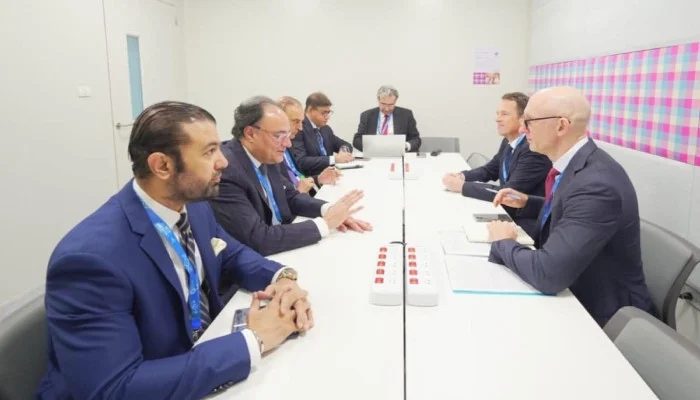
Federal Minister for Finance and Revenue Senator Muhammad Aurangzeb and State Bank of Pakistan Governor Jameel Ahmad met with representatives of Fitch Ratings on the sidelines of the World Bank Group-IMF Annual Meetings 2026 in Bangkok, Thailand, and discussed Pakistan's economic performance and sovereign credit outlook.
The finance minister highlighted restored access to international capital markets, fiscal consolidation, and sustained primary surpluses, a news release said on Friday. He outlined inflation trends, monetary policy, exchange rate stability, and the contained current account deficit.
The discussions also covered reserve accumulation, reduced forward liabilities, and stronger external buffers to withstand economic shocks. The delegation highlighted improvements in debt sustainability, declining debt-servicing costs, longer borrowing maturities, and bilateral rollover assurances.
It also reaffirmed its commitment to completing the IMF programme, implementing structural reforms, and promoting export-led growth. The finance minister further discussed trade and investment engagement with the United States and sought Fitch's assessment of the requirements for advancing Pakistan towards the BB rating category.
Meanwhile, Finance Minister Muhammad Aurangzeb on Friday met Under Secretary for International Affairs at the US Department of the Treasury, Erin Browne, and discussed Pakistan's economic outlook, reform agenda, and external financing strategy. The minister highlighted Pakistan's 3 billion dollar Eurobond issuance in September and plans to diversify financing through Sukuk, Panda bonds, and other instruments, the news release said.
He outlined progress under the IMF programme, tax reforms, three consecutive years of primary surpluses, and foreign exchange reserves of approximately 21.6 billion dollars. The discussions also covered the regional conflict's implications for energy, inflation, and food security, as well as measures to ensure supplies and prepare for winter demand.
The ongoing engagements reflect Pakistan's broader strategy to restore macro-economic stability and strengthen investor confidence across international markets. Economic observers noted that these high-level meetings are crucial for securing long-term foreign investments and improving the country's sovereign ratings in the near future.