
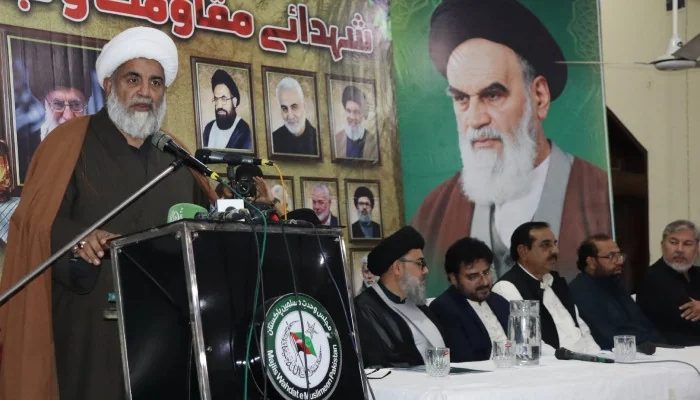
Senate Opposition Leader Allama Raja Nasir Abbas Jafri said on Sunday that Pakistan must not, under any circumstances, become a party to the war in Yemen, recalling that parliament had unanimously decided in 2015 that the country would neither participate in the conflict nor deploy its armed forces there.
"Deviating from this parliamentary resolution under the current circumstances would be contrary to Pakistan's national interests, sovereignty and aspirations of its people," he said while addressing the "Martyrs of Resistance and Renewal of Pledge Conference", organised by Majlis Wahdat-e-Muslimeen (MWM), Pakistan. Allama Nasir, who also heads the MWM as its chairman, pointed out that the Yemeni side had offered Pakistan the role of a mediator in the conflict.
He said he had written to the prime minister, drawing his attention to the sensitivity of the matter, and also questioned the foreign minister about the apparent contradiction in Pakistan's position. Instead of making Pakistan a participant in a war against any Muslim country, he stressed, Islamabad should play its role in facilitating a ceasefire, negotiations and lasting peace.
He maintained that the people of Yemen were being punished for supporting the oppressed Palestinians and raising their voices against the Israeli aggression. Yemen, he said, had expressed solidarity with the oppressed people of Gaza and challenged Israeli interests.
"We stand with the oppressed people of Yemen and condemn the atrocities committed against them, regardless of which power may be involved," he said. The opposition leader also maintained that the country's decisions must be guided by its own national interests, sovereignty and the will of its people.
He emphasized that Pakistan's foreign policy should strictly adhere to diplomatic neutrality and independent decision-making. Commenting on the broader regional situation, Allama Nasir Abbas said plans by the United States and Israel to alter the region's political and geographical map, fragment nations and eliminate resistance forces posed a serious threat to regional peace and stability.
"This conflict is not merely an issue concerning Iran; it is tied to the future of the entire region, the Palestinian cause and collective interests of the Muslim Ummah," he stressed. He urged the government to remain vigilant against external pressures.
He concluded by warning that any miscalculation in regional diplomacy could have severe long-term consequences for Pakistan's internal stability and external relations. The conference was attended by a large number of party workers, religious scholars and political activists.