
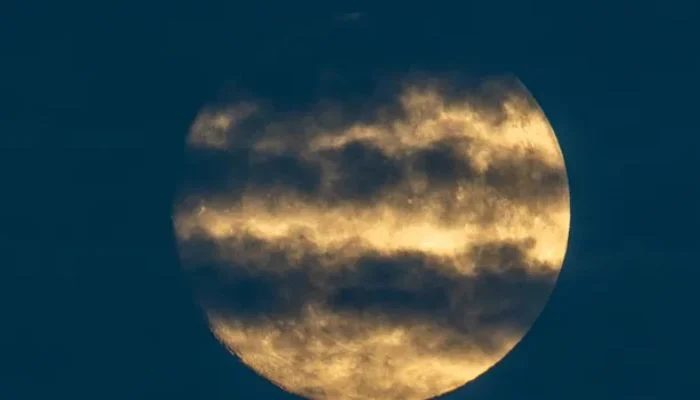
The October full moon, also known as the Hunter's Moon, peaks at 12:11 a.m. EDT on Monday, October 26, 2026. The moon rises in the eastern sky around sunset on October 25, when it may appear orange or reddish as Earth's atmosphere scatters blue light.
It can also look larger near the horizon due to the "moon illusion," though its actual size is unchanged. The moon looks full for about three nights, so viewers have more than one chance to catch it and witness its stunning beauty across the night sky.
Why is it called the Hunter's Moon? The name comes from the season after the harvest, when fields were cleared, and bright evening moonlight traditionally helped hunters track game before winter approached.
It follows September's Harvest Moon in the lunar cycle. Other cultural traditions and historical calendars often call it by different names, such as the Migrating Moon, Ice Moon, or Blood Moon depending on the region.
Shortly after moonrise, viewers in the United States and other regions can locate Saturn just 20 degrees below the Moon. This alignment provides a wonderful opportunity for amateur astronomers and stargazers alike.
At dawn on October 26, one can find Jupiter about halfway up in the southeastern sky between Mars and the star Regulus, creating a remarkable planetary configuration visible to the naked eye. A tripod and a remote shutter release can be used to stabilize the camera for capturing these celestial events.
For photographing the Moon's surface, a minimum focal length of 400 mm should be used. Meanwhile, for landscape astrophotography incorporating the horizon, a 12-50 mm lens would be optimal to capture both the expansive scenery and the bright lunar orb in a single frame.
A special astronomy application may help to determine the precise position of the moonrise. The Hunter's Moon will be preceded by the Beaver Moon on November 24 and the Cold Moon on December 23; both are supermoons.
To get the best views, go to an open area where there is no obstruction on the eastern horizon and arrive 20 minutes before the moonrise, because hills, buildings, and even the haze may prevent you from seeing it at the moment of its rising.