
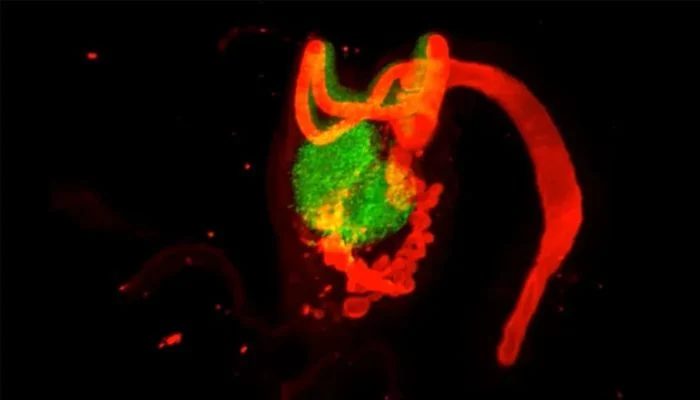
A tiny female reproductive structure dismissed as useless and dropped from anatomy textbooks for decades may actually play a major role in ovarian health and fertility, new research suggests. The rete ovarii, first described in humans in 1870, appeared in early editions of Gray's Anatomy before quietly disappearing from medical texts.
For a long time, researchers classified it as a "functionless vestige" - a leftover with no purpose. But a Duke University Medical Centre team has found the horseshoe-shaped structure is far more active than previously believed.
Their research, published in eLife, identified three distinct regions of the rete ovarii and found that fluid flows in one direction: from the structure into the ovary. Researchers also found that the rete ovarii secretes proteins, including IGFBP2, which aids in regulating follicle development.
The structure also responds to estrogen, contains hormone receptors, and sits near blood vessels, nerves, and immune cells - leading scientists to describe it as an "antenna" for the ovary. One of the researchers, Blanche Capel, said: "We think it is regulating the timing or rate of ovulation.
We could perhaps use it somehow to extend the female reproductive lifespan." The findings have sparked outrage online, with critics pointing to a long history of neglecting women in health research. The National Institutes of Health (NIH) did not require women in federally funded clinical trials until 1993.
This discovery highlights how much of female anatomy remains under-researched. Scientists are now calling for a more inclusive approach to biological studies to ensure that such structures are not overlooked in the future.
The rete ovarii's proximity to critical biological systems suggests it acts as a communication hub. By monitoring hormonal signals, it likely coordinates the maturation of eggs, a process vital for fertility.
This revelation could change how reproductive health issues are diagnosed and treated. Medical historians note that the exclusion of this organ from textbooks reflects a broader bias in historical medical literature.
By re-evaluating these "vestigial" structures, modern science is correcting past oversights. The team at Duke University plans to conduct further studies to map the full extent of the rete ovarii's influence on hormonal cycles.
As the scientific community digests these findings, there is a growing consensus that the female reproductive system is far more complex than previously documented. Future research will likely focus on how this organ interacts with other endocrine glands to maintain overall health.
Ultimately, the rete ovarii serves as a reminder that biological "leftovers" are often just functions we have yet to understand. The shift in perspective marks a significant step forward in reproductive biology and women's health advocacy.