
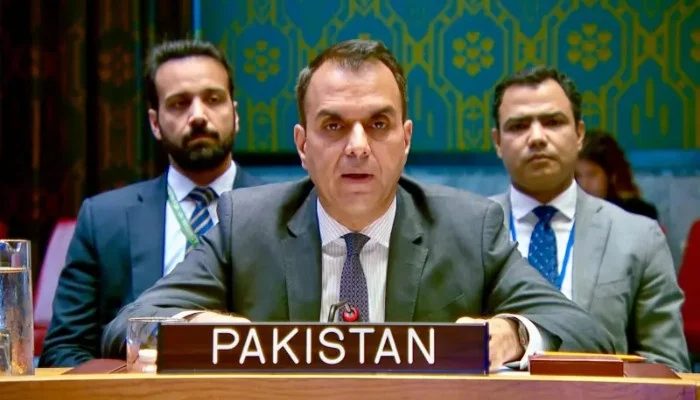
Pakistan on Thursday strongly condemned Houthi attacks on Saudi Arabia, reaffirming its support for the kingdom's security and right to self-defence amid escalating regional tensions. Speaking at a United Nations Security Council (UN Security Council) debate on the Middle East, Pakistan's acting Permanent Representative, Ambassador Usman Jadoon, said, "These attacks must cease immediately." Jadoon reiterated Islamabad's support for efforts to secure a peaceful settlement in Yemen and backed the UN special envoy's efforts to resume dialogue aimed at achieving a comprehensive and lasting peace in the country.
The UN acting Special Coordinator for the Middle East Peace Process, Ramiz Alakbarov, warned that the Gaza ceasefire remained extremely fragile, with continued Israeli operations causing Palestinian casualties. Citing Gaza's Ministry of Health, he said around 1,500 Palestinians, including more than 320 children and 140 women, had been killed since the ceasefire.
"During my visit to Gaza on Sunday, I witnessed that, for Palestinians living along the Yellow Line, the ceasefire exists in name only," he said. Alakbarov warned that winter could worsen conditions for 950,000 people living in flood-risk areas, while more than 4,000 buildings used as shelters faced possible collapse.
He called for full implementation of the Gaza plan, including Hamas's disarmament, Israeli forces' withdrawal, deployment of an international stabilisation force and transfer of governance to the National Committee for the Administration of Gaza. Palestinian Deputy Permanent Observer Majed Bamya accused Israel of continuing to kill Palestinians despite the ceasefire, questioning how Israeli militarism could be justified while Palestinians were expected to remain pacifist.
He said more than 1,000 Palestinians had been killed in the occupied West Bank, including East Jerusalem, over three years amid violence by Israeli settlers and soldiers. He called for Gaza and the West Bank to be reunited under the Palestinian Authority, with one government, legal system and security authority, stressing that "occupation must end." Meanwhile, Pakistan called for a full ceasefire, unhindered humanitarian aid, immediate reconstruction, support for the United Nations Relief and Works Agency (UNRWA) and the release of withheld Palestinian revenues.
Its representative, Jadoon, condemned Israeli incursions into the Al-Aqsa Mosque, rejected forced displacement and the fragmentation of Gaza and the occupied West Bank, and called for an end to settlement expansion and settler violence. He warned that Israel's E1 project, approved last year, threatened Palestinian territorial contiguity by further separating East Jerusalem from the West Bank.
Jadoon called for a "credible, time-bound and irreversible" process to establish an independent, sovereign and contiguous Palestinian state on the pre-1967 borders, with Al-Quds Al-Sharif as its capital. Citing Security Council Resolution 2803, the Comprehensive Plan to End the Gaza Conflict and the New York Declaration, he reaffirmed Pakistan's support for their full implementation and the two-state solution.
On the other hand, France warned that settlement expansion, settler violence and financial pressure on the Palestinian Authority were fuelling instability. Britain called for the E1 project to be halted, its tender withdrawn, settlement expansion ended and humanitarian restrictions lifted to ensure regional stability.