
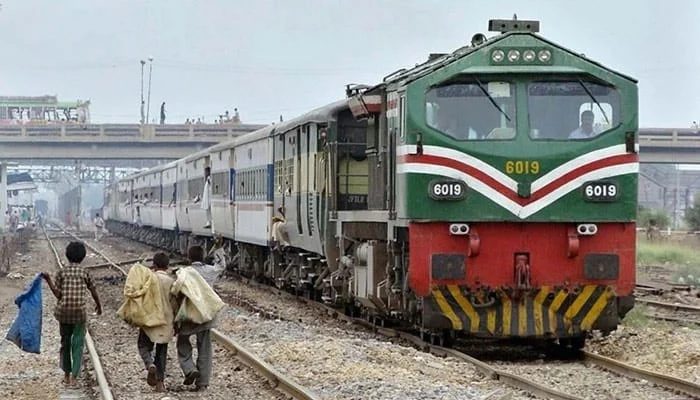
Prime Minister Shehbaz Sharif on Wednesday directed authorities to expedite the upgradation of Main Line-1 (ML-1) and implement corporate-style reforms in Pakistan Railways to ensure the institution becomes economically self-sufficient. The prime minister ordered that ML-1 be developed on a commercial basis by utilizing retrieved railway land worth billions of rupees.
Chairing a meeting on Pakistan Railways reforms, he commended the joint efforts of the National Accountability Bureau (NAB) and the Ministry of Railways in identifying and retrieving encroached land. Separately, while chairing a review meeting on access to finance, the prime minister directed authorities to remove obstacles hindering the provision of financial resources to the housing, agriculture, and Small and Medium Enterprises (SME) sectors, emphasizing that the lending system must be made more effective.
He instructed the Small and Medium Enterprises Development Authority (SMEDA) to take effective measures to enhance the capacity of SMEs. The meeting also reviewed the performance of the National Bank of Pakistan (NBP) regarding lending.
The prime minister noted that a 76 percent loan approval rate in housing finance by the NBP was commendable. He directed other provinces to accelerate the digitization of land records, following the Punjab model, to facilitate housing finance for banks.
The government aims to create a more robust financial ecosystem that supports grassroots economic growth and provides easier access to capital for the common citizen. In another meeting, the prime minister stated that the surge of terrorism in Khyber Pakhtunkhwa (KP) must be stamped out at all costs.
He was speaking to Federal Minister for Kashmir Affairs and Gilgit-Baltistan Engineer Amir Muqam. The prime minister reiterated that the state would not tolerate any threats to national security and that the provincial administration would be fully supported in maintaining law and order.
Meanwhile, the prime minister directed Planning Minister Ahsan Iqbal to contact Jamaat-e-Islami Deputy Emir Liaquat Baloch as the government seeks to advance dialogue with the party. According to a statement from the PM Office, Ahsan Iqbal contacted Liaquat Baloch on the prime minister's special instructions to convey Shehbaz Sharif's message to the Jamaat-e-Islami leadership.
This move is seen as part of a broader effort to foster political stability and national consensus on key economic and security challenges facing the country. The administration remains focused on balancing fiscal discipline with the need for infrastructure development.
By leveraging dormant assets like railway land, the government hopes to reduce the burden on the national exchequer while modernizing the transport sector. The ML-1 project remains a cornerstone of the government's infrastructure strategy, promising to revolutionize rail travel and freight logistics across the country.
Furthermore, the emphasis on SME development and agricultural financing reflects a shift toward inclusive growth. By streamlining the lending process, the government intends to empower small business owners and farmers, who form the backbone of the national economy.
The integration of digital land records is expected to further reduce bureaucratic hurdles and increase transparency in the financial sector. As the government navigates these complex challenges, the coordination between various ministries and departments is being closely monitored.
The prime minister has made it clear that performance and efficiency will be the primary metrics for success in these initiatives. The upcoming months will be critical in determining the pace at which these reforms are implemented and their subsequent impact on the national economy.
The leadership has also signaled its willingness to engage with political stakeholders to ensure that national policies have broad-based support. By reaching out to opposition parties and focusing on consensus-building, the government aims to create a stable environment conducive to long-term investment and development.
In conclusion, the dual focus on infrastructure modernization and financial reform underscores the government's commitment to steering Pakistan toward economic stability. With the successful retrieval of encroached land and the push for digital governance, the administration is laying the groundwork for a more efficient and prosperous future for all citizens.