
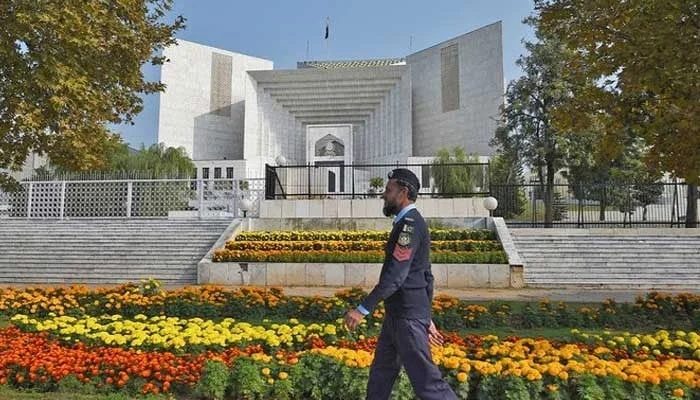
The Supreme Court has observed that a marriage may be dissolved by a court, but neither spouse should be judicially deprived of a lawful right, nor judicially burdened with a stigma, without a foundation in law and evidence. A five-member larger bench of the apex court, headed by Justice Shahid Waheed, announced a judgment in two family suits challenging two judgments announced by the Peshawar High Court, Abbottabad Bench, on November 7, 2024, and January 14, 2025.
Other members of the bench included Justice Naeem Akhtar Afghan, Justice Muhammad Hashim Khan Kakar, Justice Ishtiaq Ibrahim, and Justice Miangul Hassan Aurangzeb. Two petitioners, Mst.
Zainab Bibi and Mst. Iram Naz Begum, had filed appeals against the judgments of the Peshawar High Court, Abbottabad Bench.
The two wives had approached the Supreme Court with two principal grievances. First, that their marriages could not lawfully have been dissolved through Khula because they had neither sought nor consented to Khula; rather, their cases were founded upon cruelty and the marriages ought to have been dissolved on that ground.
Second, that their claims for maintenance, dower, and dowry articles ought to have been allowed in their entirety. The Supreme Court converted the petitions into appeals and allowed them.
"We accordingly hold that the marriages of the petitioners are liable to dissolution on the ground of Shiqaq falling within Section 2(ix) of the Dissolution of Muslim Marriages Act, 1939, and not on the basis of Khula," says a 15-page judgment authored by Justice Shahid Waheed.
The court held that the directions requiring the petitioners to return, surrender, or waive their dower merely as a consequence of Khula shall consequently stand set aside, adding that their entitlement to dower shall be determined in accordance with the Act of 1939 and the findings otherwise sustainable on the record.
The court held that the findings concerning maintenance and dowry articles, having been examined by the courts below and not having been shown to suffer from any error of law, jurisdictional defect, material misreading, or non-reading of evidence warranting interference under Article 199 of the Constitution, shall remain undisturbed.
"The remaining findings, including those concerning maintenance and dowry articles, shall remain intact to the extent stated earlier above and there shall be no order as to costs," says the judgment. The court ruled that marriage, in Islam, is a solemn covenant founded upon affection, tranquillity, mutual respect, and the discharge of reciprocal obligations.
"Its dissolution, where necessary, is therefore not merely a matter of terminating a legal relationship; it is an exercise of judicial power which must be undertaken according to law, with due regard to the rights, dignity, and honour of both parties," says the judgment.