
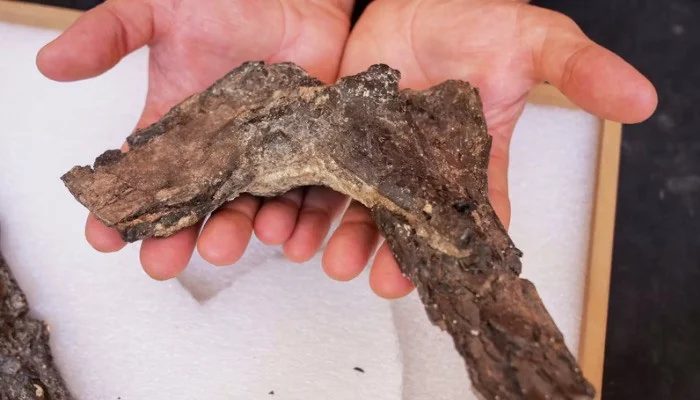
Researchers studying a 115-million-year-old dinosaur bone say they have found the strongest evidence yet that red blood cells can survive fossilisation, a discovery that could open new windows into dinosaur biology. The research paper, published Monday in the Proceedings of the National Academy of Sciences, focused on the fossilised hind limb of a small predatory theropod known as Aratasaurus museunacionali, found in northeastern Brazil in 2008.
The researchers, headed by Prof. Kliti Grice from Curtin University, used microscopic and chemical analysis to uncover oval shapes similar to red blood cells in the microchannels in the bone that were used to transport blood.
More importantly, it was revealed through chemical tests that heme, the iron compound contained in haemoglobin and responsible for carrying oxygen, was present in those shapes. In the authors' view, it is the first ever instance of detecting heme in a dinosaur fossil in situ.
The scientists believe that quick burial in an oxygen-poor environment and hausmannite, a manganese oxide mineral, played a role in this process. Grice said, "This really is a landmark discovery," adding that the findings challenge longstanding assumptions that biomolecules like haemoglobin can't survive deep time.
The researchers say the approach could be applied to other fossils, and that museum collections worldwide may hold hidden molecular information never investigated. However, not all experts are convinced.
Mary Schweitzer of North Carolina State University questioned whether the structures truly match non-mammalian red blood cells, which typically retain nuclei and show a distinctive bulge. She said the concave shapes found do not fit that profile.
Still, Schweitzer praised the team's use of multiple analytical techniques, calling the work an exciting advancement. The authors stress that their findings do not imply DNA survival and are a long way from "Jurassic Park."