
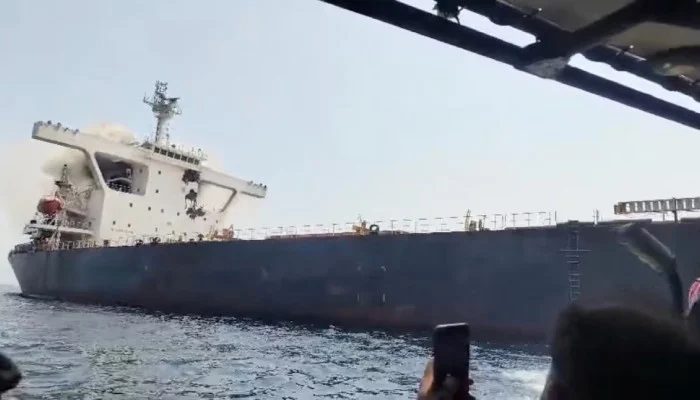
LONDON/RIYADH: A container ship and a dry bulk carrier have both sunk near the Strait of Hormuz in the past 24 hours after being hit by projectiles in separate incidents, maritime officials said on Wednesday. Attacks around the waterway have surged over the past 10 days, with Iran saying it is stepping up strikes in response to the US blockade of its ports and tougher sanctions introduced last month.
The Singapore-flagged GFS Pride, a small container vessel with a capacity of 2,824 20-foot equivalent units (TEU), sank while sailing through the strait, according to maritime security sources. "GFS Pride sustained damage and a fire on board, and has since sunk.
All 21 crew members were safely evacuated. No injuries have been reported," the Maritime and Port Authority of Singapore (MPA) said in a statement on Wednesday.
In a separate incident, the Antigua and Barbuda-flagged Cape Dao sank close to the strait, weeks after being struck by a projectile on 23 September, data from UN shipping agency the International Maritime Organisation (IMO) showed on Wednesday. One crew member was killed, the rest of the crew evacuated straight after the strike, maritime sources said.
Its UAE-based manager Peonies Shipmanagement FZE could not be immediately reached for comment. The GFS Pride and Cape Dao are the second and third vessels to have sunk since the US-Iran war began on 28 February, according to an analysis of IMO casualty data.
"MPA is deeply concerned about the continued attacks on commercial shipping in the Strait of Hormuz," the Singapore authority said. "Such attacks are unprovoked, unjustifiable and a breach of international law." GFS Pride's UAE-based manager, GFS Ship Management FZE, could not be immediately reached for comment.
"The latest incidents reinforce the continuing threat to commercial shipping transiting the Strait of Hormuz," maritime risk management company MARISKS said on Wednesday. "The threat is not confined to tankers, with container vessels and bulk carriers also sustaining serious damage."
Global trade routes remain on high alert as insurance premiums for vessels traversing the region have spiked significantly. Analysts suggest that the escalation in the Strait of Hormuz is a direct consequence of the ongoing geopolitical tensions between Tehran and Washington.
Shipping companies are now advising vessels to take longer routes around the Cape of Good Hope to avoid the volatile waterway. This shift is expected to increase fuel consumption and delivery times for goods destined for Asian and European markets.
The international community has called for restraint, urging both sides to adhere to maritime safety protocols. However, with no immediate signs of de-escalation, the situation remains precarious for merchant sailors operating in the area.
Further updates are expected as the IMO continues to monitor the wreckage and environmental impact of the sunken vessels. Authorities are currently coordinating salvage operations to ensure the safety of other ships navigating the busy maritime corridor.