
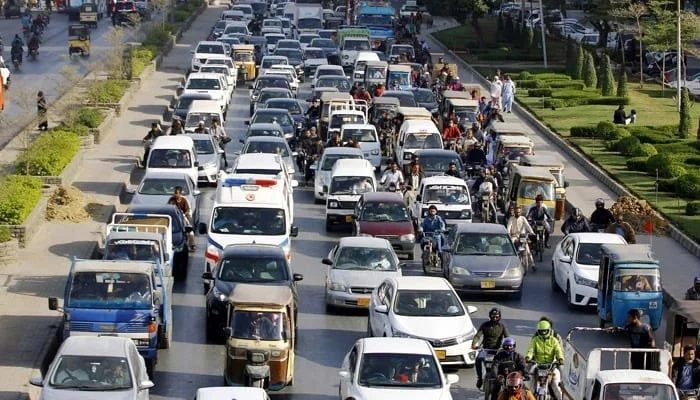
Pakistan's national vehicle fleet has ballooned by more than 770 percent over the last three decades, surging from 4.47 million vehicles in 1990 to over 39 million by 2025, according to a recent study published by the Pakistan Institute of Development Economics (PIDE). Meanwhile, road transport carbon dioxide (CO2) emissions climbed from approximately 13.8 million tonnes in 1990 to 43.6 million tonnes by 2023.
Interestingly, the study noted two distinct temporary dips in this long-term environmental trajectory: a sharp reduction in 2020 due to Covid-19 lockdowns, and another decline in 2022 driven by catastrophic nationwide flooding and soaring petroleum prices. However, emission levels quickly rebounded to peak normalised highs following the removal of these disruptions.
The research paper, titled "More Vehicles, Less Mobility: Understanding the Urban Transport Paradox in Pakistan" and authored by Raheel Hasan Qadar and Irem Batool, reveals that the country's rapid motorisation has been overwhelmingly propelled by private transport rather than public transit. According to the findings, private vehicles - including cars, motorcycles and jeeps - grew from 1.42 million in 1990 to 35.87 million in 2025.
Meanwhile, public transport vehicles like buses, vans and rickshaws, alongside other categories, experienced a much slower growth rate, remaining relatively stable at around three to four million vehicles throughout the study period. Researchers point to consumer auto financing as a major catalyst behind the trend.
The expansion of credit lowered upfront purchase costs and allowed households to spread payments over time, with a sharp spike in financing after 2015 directly coinciding with accelerated private vehicle acquisitions. This automobile-heavy expansion has triggered severe environmental and public health consequences across Pakistan's major urban centres, including Karachi, Lahore, Islamabad and Rawalpindi.
Urban air quality has deteriorated sharply. In Lahore, transport accounts for roughly 81.3 percent of the city's estimated CO2 emissions, with poor air quality estimated to cut average life expectancy by about seven years.
During severe smog crises in November 2024, the Air Quality Index (AQI) surpassed 1,900 in Lahore and 2,000 in Multan. In other metro areas, transport is responsible for roughly 53 percent of emissions in Islamabad-Rawalpindi, 51 percent in Peshawar and 33 percent in Karachi.
The authors caution that traditional infrastructure fixes - such as road widening and building additional flyovers - often backfire by inducing further private vehicle demand. These measures ultimately worsen congestion, lengthen travel distances through urban sprawl and exacerbate social inequalities for populations without private cars.
The study calls for a paradigm shift toward integrated public transit systems to mitigate these long-term urban challenges.