
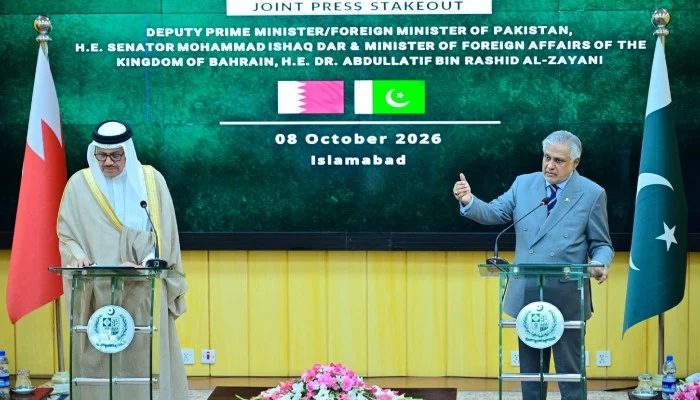
ISLAMABAD/ RAWALPINDI: Pakistan on Thursday expressed satisfaction over the positive trajectory of bilateral relations with Bahrain and underscored its commitment to further strengthening cooperation with the country in diverse fields, including trade, investment, energy and human resource development. The occasion was the visit of Dr. Abdullatif bin Rashid Al Zayani, Foreign Minister of the Kingdom of Bahrain, who separately called on Prime Minister Shehbaz Sharif and President Asif Ali Zardari.
Dr Zayani reached Islamabad on Wednesday night. Zayani conducted a restricted meeting with President Zardari, which was followed by delegation-level discussions.
Pakistan attaches "great importance" to its relations with Bahrain, and desires to further strengthen bilateral cooperation, highlighting opportunities for this cooperation in "food security, IT and digital services, construction, mining, port handling, research and development, tourism and healthcare", said the president according to a statement from his office.
It further said Pakistan was ready to further strengthening cooperation in manpower, logistics, training and defence hardware. In his remarks, Dr Zayani commended Pakistan's courageous efforts to mediate amid the current regional situation and bring warring parties to the table, saying Pakistan's actions had "helped save many lives".
He also appreciated Pakistan's peace efforts and congratulated it on its successful tenure as a non-permanent member of the UN Security Council. Earlier, Dr Zayani co-chaired the third session of the Pakistan-Bahrain Joint Ministerial Commission (JMC) along with Deputy Prime Minister/Foreign Minister of Pakistan Ishaq Dar at the Foreign Office here.
Following the lengthy sessions of the Joint Ministerial Commission, he assured that Bahrain was working to "speed up" the approval of a free trade agreement between Pakistan and the Gulf Cooperation Council (GCC). Dr Zayani also addressed a joint press briefing with Dar, in which he said the JMC meeting covered "more than 15 fields".
He said both sides had agreed to establish a joint working group on trade and investment, as well as to convene the joint working group on energy next month on oil, gas and minerals. They also agreed to take forward cooperation in food security, information technology, law enforcement, media, labour mobility, health, education, culture and sports.
"We also committed to finalising the GCC-Pakistan free trade agreement," he said, referring to the potential deal that was said to be near finalisation in late 2025. The minister said Bahrain, having the GCC presidency, was working to "speed up the signing or the approval of GCC-Pakistan FTA".
Responding to a query, the visiting dignitary described the Pakistan-Bahrain relations as "very healthy and strong". "It is really valued by the people of Bahrain," he added.
He appreciated Islamabad's "principled positions on the ongoing crisis", including its support in March for a United Nations Security Council (UNSC) resolution condemning Iranian attacks on GCC countries. The minister also praised Pakistan's "efforts alongside other partners to facilitate US-Iran dialogue and de-escalation, including by hosting the Islamabad talks" in April.
Dr Zayani strongly condemned the recent deadly "terrorist attacks" on Saudi Arabia's Abha International Airport and King Khalid International Airport. He also condemned the "Houthi terrorist militia's attacks on civilians and civilian facilities in the Kingdom of Saudi Arabia and its assault" on the holy cities of Makkah and Madina.
In his remarks, Dar appreciated Bahrain's 'warm welcome' to the Islamabad MoU and the Makkah Joint Defence Agreement and said it was "keen to translate strong bilateral political relations into deeper trade and investment ties". On the regional front, Pakistan said it was committed to constructive engagements with all parties "to build trust, bridge gaps, and promote lasting peace, security and stability in the region".
He said, "A key outcome of the session was the strengthening of our institutional framework through the operationalisation of several joint working groups," adding that these mechanisms will help ensure effective implementation of the decisions taken by the JMC. "Both sides also agreed to enhance cooperation in trade and investment promotion, industrial collaboration, agriculture and food security, skills development, higher education, information technology, logistics and maritime affairs, among many other areas." They particularly welcomed closer engagement between the business communities of the two countries.
Both sides reaffirmed their commitment to strengthening cooperation in labour mobility, vocational training and human resource development, with a view to creating new opportunities for skilled Pakistani professionals and workers. "We discussed the need to ensure the safety and freedom of navigation through the Strait of Hormuz and the Bab al-Mandab, given their importance to regional and global food and energy security," said Dar.
The ministers also discussed the "grave situation in Palestine". Dar also raised the issue of India's unilateral decision to place the Indus Waters Treaty (IWT) in abeyance, terming it a material breach of international law.
Striking a precautionary note, Dar told the JMC meeting that Pakistan was committed to increasing trade with Bahrain to the $1 billion target set earlier. Abdullatif Bin Rashid Al Zayani also called on Field Marshal Asim Munir, Chief of Army Staff and Chief of Defence Forces (Chief of Army Staff (COAS) & CDF), at the General Headquarters (GHQ), Rawalpindi.
Matters of mutual interest, regional security situation and bilateral defence and security came under discussion.