
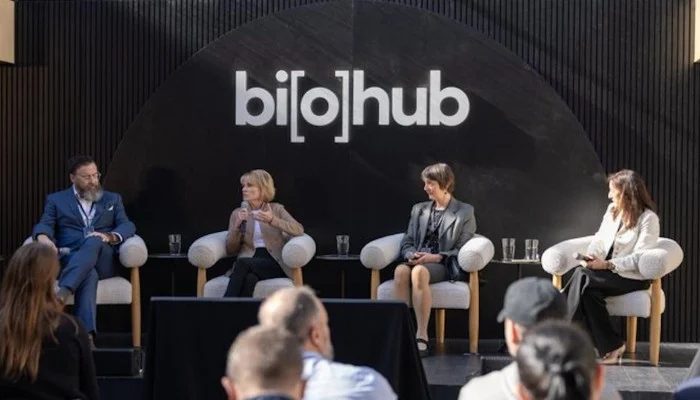
REDWOOD CITY, CA: Biohub, the US Department of Energy, the National Institutes of Health and new funding partners have announced a major expansion of an international effort to generate and make accessible the data enabling predictive AI models of biology. Together, the organisations are investing $1.8 billion in funding, data, computation and new measurement technology - the largest coordinated commitment to generating AI-ready biological data to date.
The result will be an open resource for the research community that provides the foundation for greater understanding and, ultimately, treatment of human diseases. As part of the announcement, the US-based nonprofit biomedical research organisation - Biohub -- has partnered with the US Department of Energy (DOE) Office of Science and the National Institutes of Health (NIH) to advance the frontier of artificial intelligence in biology.
The DOE will invest more than $500 million over five years in lab measurement, modeling and computation toward the international effort to build an AI-ready open data resource. The NIH will coordinate the contribution of relevant datasets, repositories and knowledge bases developed through more than $500 million in prior federal investment aligned to the initiative.
Biohub will work with the NIH to standardise these datasets for AI model training. In addition, Google DeepMind, Isomorphic Labs, and Meta Platforms are collectively investing $300 million in the Virtual Biology Initiative to create the technologies and multi-modal datasets needed to build predictive models of life.
These datasets will enable the global scientific community to collectively build and use AI models that allow researchers to ask, predict and answer biological questions digitally, accelerating the path to new ways of preventing and treating diseases. The initiative will deliver the foundational measurements to train these models, expanding cell response data to interventions across far more cell types and conditions than have yet been studied, and building and validating technologies for studying cells and cellular interactions at greater scale, speed and accuracy.
"An accurate predictive model of biology could dramatically accelerate scientific discovery by enabling scientists to perform experiments digitally. The insights that come from this could unlock a far greater understanding of disease and open up completely new paths for cures," said Biohub Head of Science Alex Rives.
"Because of this potential, the creation of a virtual cell is one of the most important challenges for the next era of science. It will require coordinated data generation efforts at a national and international scale, which is why these partners are coming together.
We invite the worldwide scientific community to join us in this project.".