
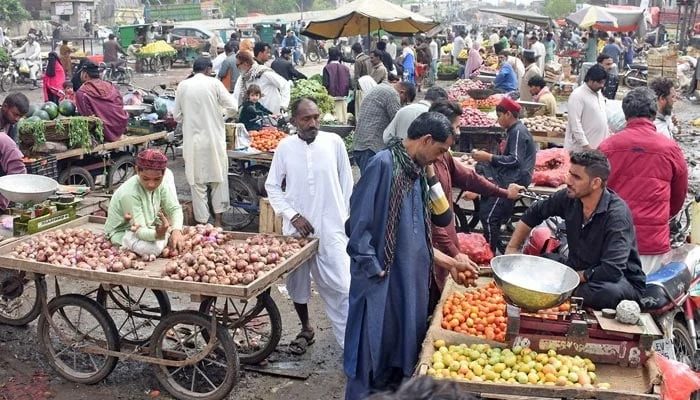
The National Price Monitoring Committee (NPMC) was informed on Thursday that some major items were pushing up CPI-based inflation in the current fiscal year, including petrol, electricity charges, house rent, onions, fresh milk, wheat flour (average), LPG and wheat. Islamabad is the most expensive city, keeping in view the prices of 17 essential items compared to all the other provinces such as Punjab, Sindh, KP and Balochistan.
The price of 20 kg wheat flour bag stands at Rs2,993, Rice Basmati broken 1 kg Rs275, Rice Irri 6/9 per kg Rs179, beef with bone 1 kg Rs1,491, mutton 1 kg Rs2,849, chicken Rs375 per one kg, vegetable ghee 1 kg Rs615, onion Rs243 per kg, tomato Rs208 per kg, potatoes Rs72 per kg, sugar Rs150 per kg, garlic Rs494 per kg, pulse moong Rs494 per kg, pulse mash Rs515 per kg, pulse gram Rs311 per kg and others.
If the CPI-based inflation goes up in the months ahead, the IMF might pressurise Pakistan and its central bank to further tighten the monetary policy. So it is the appropriate time to take control of rising prices and curtail the escalating prices.
Federal Minister for Planning Ahsan Iqbal chaired a meeting of the National Price Monitoring Committee (NPMC) here on Wednesday to review the monthly and weekly inflation situation, wholesale-retail price gaps and prices of essential commodities as well as implementation of previous decisions.
The minister expressed concern over rising prices of essential commodities, particularly wheat flour, and directed provincial and district administrations to strengthen monitoring of supplies, market arrivals, hoarding, profiteering and unjustified price increases. The meeting was informed that CPI inflation stood at 10.3 percent year-on-year in September 2026, compared to 11.1 percent in August, while average inflation during July-September FY2026-27 stood at 10.2 percent.
WPI inflation increased to 13.3 percent year-on-year, while weekly SPI for the week ended October 1 recorded an 11.53 percent year-on-year increase. Major annual increases were recorded in onions, LPG, electricity, diesel, petrol and wheat flour, while chicken, garlic, gram pulse and LPG recorded notable weekly increases.
Ahsan Iqbal directed the authorities concerned to compare current transport fares with fares prevailing after the previous fuel price increase to determine whether the latest increase in fuel prices had resulted in any disproportionate rise in fares. He also directed the Ministry of National Food Security and Research to examine why DAP prices remained high in Pakistan despite a decline in international prices, stressing that the benefit of lower international prices should be reflected in the domestic market.
The minister directed that the inspection and quality assessment report regarding ghee, edible oil and milk products be submitted within one week. He said that if the industry had proposed The minister directed provincial governments to closely monitor wholesale and retail prices and take enforcement action where unjustified gaps existed, particularly in major markets including Lahore and Karachi.
He also called for close monitoring of supply chains and distribution costs to prevent disproportionate pass-through of fuel price increases to essential food prices. Ahsan Iqbal further directed authorities to strengthen measures against hoarding, profiteering and overcharging and ensure uninterrupted supplies of essential commodities, particularly wheat flour, onions and other perishables.
He also directed Ogra to take effective measures to reduce the gap between notified and prevailing market prices of LPG cylinders. The minister stressed that price monitoring should focus not only on statistics but also on identifying the causes of price increases, addressing market distortions and ensuring timely enforcement to protect consumers.